Some companies skip AI disclosure in customer service on purpose. They assume that customers won’t hang up if they don’t know it’s AI. But the data shows that hiding it causes a bigger problem than it solves. The fix is simple, and the whole approach comes down to five rules:
- Disclose before it fails. Every AI agent can misunderstand, so say it’s AI before that happens.
- Keep the greeting under 15 seconds. Say it’s AI, what it can help with, and how to reach a person.
- Transfer on request. When a customer asks for an agent, put them through. No loops.
- Judge greetings by repeat contacts. Containment alone can fool you.
- Write one standard, adapt per market. Let legal fine-tune it country by country.
The good news: with Call Center Studio’s AI Connector, you can design your greeting and handoff right in the panel you already use.
Now let’s walk through each rule, starting with why hiding the AI agent backfires.
Why Hiding the AI Agent Backfires in AI Disclosure
Zingtree research found that 64% of consumers don’t mind interacting with AI when it resolves their issue. The same study of 1,040 US consumers found that nearly seven in 10 would abandon AI after two or fewer failures.
Read those two numbers together. Customers aren’t rejecting AI. They’re rejecting AI that fails, and failure hurts more when it’s disguised. Someone who knew it was an AI agent forgives a misheard word; someone who thought it was a person feels tricked.
Rule #1: If your AI agent could fail on this call (and every AI agent can), then tell the customer it’s an AI agent before it does.
AI Disclosure in Customer Service: What a Good Greeting Sounds Like
Good disclosure has to be short, plain, and paired with an exit. Compare these examples:
- Too vague: “Welcome to our new intelligent experience!” (What does that even mean?)
- Too long: A 30-second paragraph about data, models, and privacy before the customer says a word.
- Just right: “Hi, you’re speaking with our AI agent. I can help with orders, bookings, and account questions. If you’d like a person at any point, just say ‘agent.'”
That third version says what you’re talking to, what it can do, and how to leave, in about 10 seconds.
The industry is moving the same way. At CCW Nashville, Sanas launched Supervised AI, where, as CX Today reports, “customers are informed that they are speaking with AI and that a human supervisor is available.” Disclosure plus a visible human route is becoming the default.
Pro tip: Don’t give the AI agent a human-sounding name and backstory. A friendly tone is fine. A fake persona is where trust breaks.
Rule #2: If your greeting can’t say “AI,” “can help with,” and “a person” in under 15 seconds, then rewrite it.
Where Disclosure Belongs: Inbound, Outbound, and Written
Your customers don’t only reach you through one channel. They call you, you call them, and they message you on chat or WhatsApp. Each channel opens a little differently, so the disclosure should fit the moment, but the rule stays the same: say it’s AI right at the start.
- Inbound calls: Disclose in the greeting, every time. Not after the first failure.
- Outbound AI calls: Appointment reminders, surveys, and information updates are often the first AI call a customer ever receives. Say who’s calling, that it’s an AI agent, and why, in the first sentence.
- Written channels: On live chat, WhatsApp, and social media, a short line at the start (“I’m the AI agent for the support team”) does the job.
Then comes the handoff: a quick transfer to a human agent who already knows what was said. We dug into that in how smarter AI handoffs protect the hard conversations.
Rule #3: If a customer says “agent,” “person,” or “human,” then transfer them. Never trap them in a “Let me try to help first” loop.
Test Your Greeting Like a Product Feature
Your first script won’t be perfect. Run variants and watch what customers do. These three signals will help you tell which version is actually working:
- Early drop-off: Are more people hanging up within the first 10 seconds with one version? If so, shorten the greeting and lead with what the AI agent can help with.
- Immediate transfer requests: If “agent” spikes right after the greeting, your disclosure may sound like a warning instead of an offer.
- Resolution and repeat contacts: The real test. A greeting that keeps people on the line but leads to callbacks isn’t winning. If callbacks go up, check what the AI agent promises in the greeting and cut anything it can’t fully handle.
Run each variant for a few weeks on comparable traffic, and listen to real calls, not just dashboards. Some flows deserve extra care regardless; our guide to where automation helps and where it must never touch is a useful checklist even outside healthcare.
Rule #4: If a greeting variant improves containment but raises repeat contacts, then it lost.
The Regulatory Backdrop (Context, Not Legal Advice)
Regulators are watching this question. This is general context, not legal advice; have your legal team confirm what applies to your markets.
- EU AI Act, Article 50. Article 50 requires providers to design AI systems that interact with people so those people are informed they’re interacting with an AI system, unless that’s obvious from the context. Per the Act’s timeline, these transparency obligations have applied since August 2, 2026. Who carries which obligation (provider or deployer) is a question for your lawyers.
- UK ICO call for evidence. On October 8, 2026, the UK Information Commissioner’s Office opened a call for evidence on agentic AI, with transparency among the areas covered. It closes on November 20, 2026.
Let’s be blunt: designing honest disclosure now is easier than retrofitting it later.
Rule #5: If you operate in several countries, then write one clear disclosure standard and let legal adjust it per market, not the other way around.

Design the Greeting and Handoff in Your Own Panel
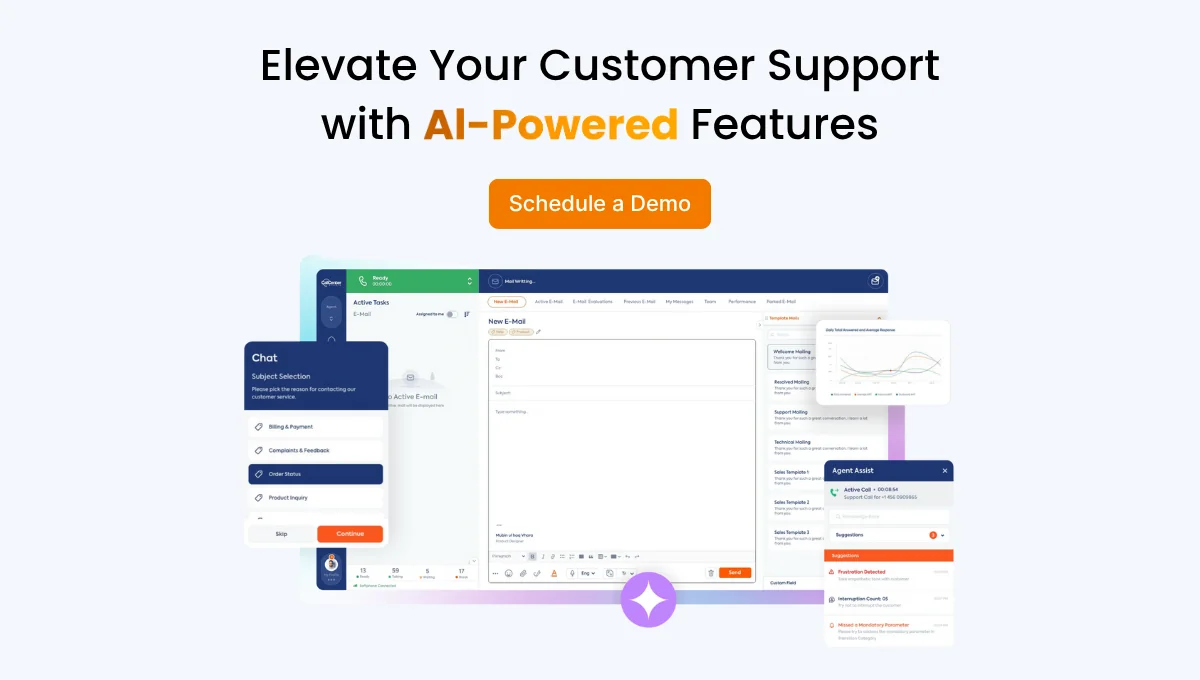
So where do these rules actually live? In your call flows. AI Connector lets you design them in the Call Center Studio panel you already use.
- Your choice of AI: Use ChatGPT, Claude, ElevenLabs, Dialogflow, Azure, Vapi, or custom AI agents.
- Instant greeting on inbound calls: Your disclosure is the first thing customers hear.
- Outbound AI calls: Automate reminders, surveys, and updates.
- Written channels too: Live chat, WhatsApp, and social media.
- Smarter IVR: Upgrade existing IVR flows without replacing them.
- Fast handoff: The right human agent in seconds, with full context.
- One panel, no lock-in: Manage, monitor, and swap AI agents in one place.
Explore the wider AI tools lineup, and use CX Quality to review the human side of every handed-off conversation.
Ready to put these rules into your call flows? Book an AI Connector demo today.
FAQ
What should an AI disclosure greeting say?
It should cover three things in about 10 to 15 seconds: that the customer is talking to an AI agent, what it can help with, and how to reach a person. For example: “Hi, you’re speaking with our AI agent. I can help with orders, bookings, and account questions. If you’d like a person at any point, just say ‘agent.'”
Is AI disclosure legally required?
It depends on where you operate. The EU AI Act includes transparency obligations for AI systems that interact with people, applicable since August 2, 2026. This isn’t legal advice; confirm requirements for your markets with a legal expert.
Does disclosing the AI agent lower containment?
Not necessarily. Zingtree’s research shows most consumers accept AI when it resolves their issue. Test greeting variants and judge them on resolution and repeat contacts, not containment alone.
Does disclosure apply to outbound AI calls?
Yes, as a design principle. Outbound calls arrive unannounced, so say up front that an AI agent is calling, on whose behalf, and why.