

Most vendors open an AI pitch with efficiency numbers. Healthcare leaders tend to open with a different question: What happens on the call where the bot gets it wrong, and the caller was describing chest pain?
That hesitation is reasonable, and it belongs at the center of the decision rather than at the end of it. An AI healthcare call center project that starts from what must never be automated ends up safer, and usually gets approved faster, than one built around deflection targets.
In this article, we draw a conservative line: what is genuinely safe to automate in patient-facing support, what should stay with people, and how to design escalation so the AI can’t get stuck holding a call it shouldn’t have.
What’s Genuinely Safe to Automate
The safe category has a clear test. The task is transactional, the answer already exists in a system of record, and getting it wrong causes inconvenience rather than harm.
- Appointment scheduling, rescheduling, and cancellation: The AI reads availability and writes a booking. A mistake produces a wrong slot, which the patient notices immediately.
- Prescription refill status: Confirming whether a refill was processed and when it will be ready is a lookup. Note that this is status, not advice about the medication.
- Hours, locations, directions, and parking: Static information that changes rarely and carries no clinical weight.
- Billing and insurance status questions: Balance, claim status, what documentation is needed. Sensitive, but not clinical.
- Pre-visit logistics: Fasting instructions, what to bring, where to check in, when to arrive, all pulled from approved content.
- Outbound appointment reminders and confirmations: One of the highest-value uses, because it reduces no-shows without asking the AI to interpret anything.
These calls are also the bulk of the volume in most patient access teams, which is what makes the conservative version of healthcare contact center automation worth doing at all.
If your patients speak several languages, treat each language as its own rollout, for reasons we set out in why one AI engine rarely fits every market.
Two conditions that keep the safe list safe
First, the AI answers from a system of record or approved content, never from its own general knowledge. Second, identity verification happens before anything patient-specific is disclosed, and the verification rules are the same ones your agents follow.
What Should Never Be Automated
This list is shorter and firmer. These calls go to a human, every time, with no clever exceptions for low-risk phrasing.
| Call type | Why it stays with a person |
| Symptom description or clinical triage | Judging urgency is clinical work; a wrong read can delay emergency care |
| Medication questions beyond status | Dosage, interactions and side effects require a clinician |
| Test and lab results | Delivery involves context, timing and the patient’s reaction |
| Anything urgent or emergent | Speed matters more than any efficiency gain, and hesitation is dangerous |
| Mental health distress | Tone, risk signals and judgment cannot be scripted |
| Complaints involving harm or safety | These carry legal and regulatory weight from the first sentence |
The pressure to soften this list usually comes from a real observation. Patients already ask AI about symptoms on their own.
A January 2026 survey found 51% of US adults had used AI to make an important health decision without consulting a professional. 62% used it to understand symptoms before deciding whether to seek care.
That is an argument for being more careful, not less. When a patient calls your number, they have left the consumer chatbot behind and entered your clinical relationship, with your name and your liability attached to the answer.
Public trust is moving the wrong way
The same survey found openness to AI in personal healthcare fell to 42% in 2026, down from 52% in 2024.
Clinicians lean the same way. In the AMA’s 2026 Physician Survey on Augmented Intelligence, 81% of physicians reported using AI professionally, while 88% named validated safety and efficacy and 86% named data privacy as critical to wider adoption.
Adoption is rising, and scrutiny is rising with it. A deflection rate you can’t defend in front of a clinical governance committee isn’t worth having.
Designing Fail-Safe Escalation
Most AI failures in healthcare support aren’t wrong answers. They’re calls the AI should have released and didn’t. Escalation design is the part of the project that deserves the most time.
- Escalate on intent, not on failure: Don’t wait for three failed attempts. Clinical keywords, urgency cues, and distress signals should transfer immediately, on the first mention.
- Bias every ambiguous case toward a human: If the intent classifier is unsure, the call transfers. Over-escalation costs an agent’s time; under-escalation costs something you can’t refund.
- Set a hard turn limit: A cap on conversational turns before automatic transfer prevents loops, which is where callers get frustrated or give up entirely.
- Never dead-end a call: If no agent is available, the flow needs a defined fallback: queue with position, callback, or the emergency instruction your clinical team has approved.
- Route to the right skill: A triage-trained nurse line and a billing queue are different destinations, and the routing rules in your IVR system should reflect that.
- Publish the exit phrase: Patients who say “agent” or “nurse” reach a person, immediately and always.
Then review what happened. Pull escalated calls weekly at first and check both directions: cases the AI should have released earlier, and cases it released unnecessarily.
How AI Connector Supports Strict Escalation and Human Handoff
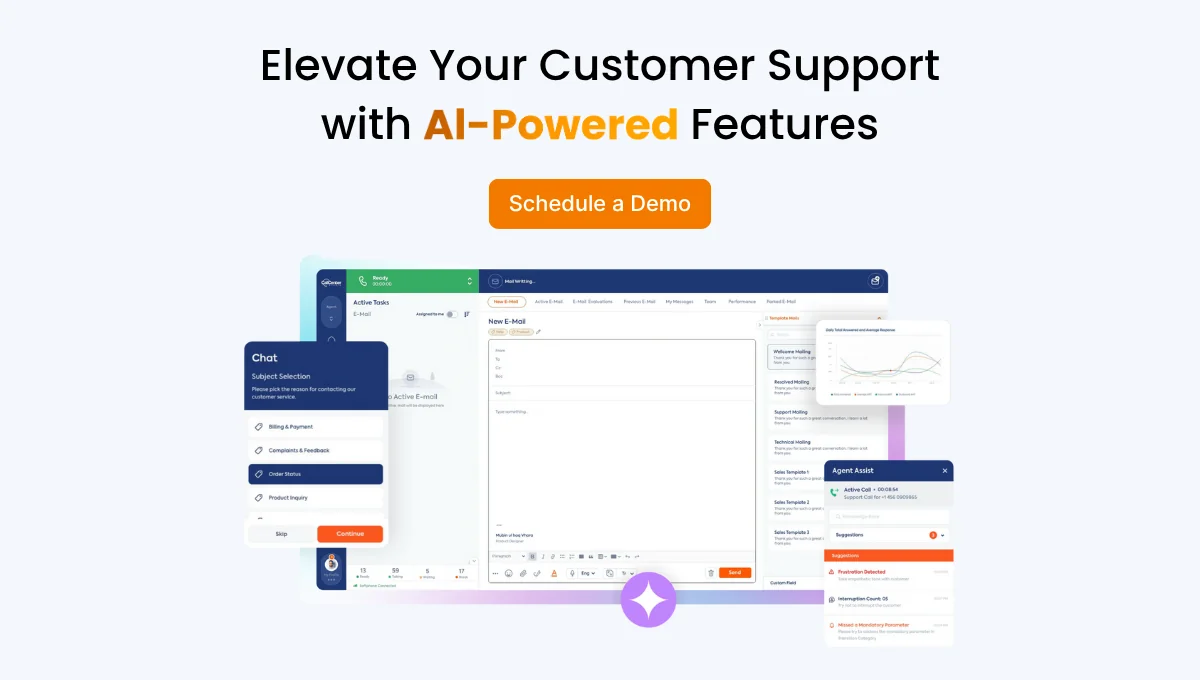
AI Connector is a bridge between your contact center and the AI engine you choose, whether that’s Call Center Studio’s own solution or a third-party assistant. Three things in it do the work described above.
Escalation rules you set, not the model
You define the conditions that force a transfer, and they hold on every call: clinical intents, urgency cues, a turn limit, an explicit request for a person.
AI Connector sits on top of your existing IVR structure and adds intent analysis to it, so those rules live in the call flow itself.
Voice and written channels run through the same setup, which matters when a patient starts on WhatsApp and calls in afterwards.
Engine-level control over scope
You define what the assistant may handle and what it can never attempt, so symptom questions and triage sit outside its remit by configuration. This is usually the first thing a clinical governance committee asks to see.
Engine choice stays yours too, across OpenAI, Google Dialogflow, Microsoft Azure, ElevenLabs, Vapi or a bot you built in-house. That decision is worth making deliberately, which we work through in how to choose the right AI engine.
Handoff that carries the context
When a request is too complex for the AI to resolve, the call transfers to a live agent within seconds with its full history and context attached.
The patient doesn’t restart a story they may have found difficult to tell the first time, and the agent picks up knowing what was already said.
All of it runs from a single panel alongside the rest of your healthcare contact center setup: call flows, assistant performance and reporting in one place.
Talk to Us About a Conservative AI Rollout
A healthcare AI rollout is judged by its worst call, not its average one. Design for that call first and the efficiency case takes care of itself.
Book a demo to see how AI Connector handles escalation and context-preserving handoff, and we’ll work through your line between automated and human together.
FAQ
What can an AI healthcare call center safely automate?
An AI healthcare call center can safely automate transactional calls where the answer already exists in a system of record. These include appointment scheduling, refill status, billing and insurance status, pre-visit instructions, and outbound appointment reminders.
Which patient calls should healthcare contact center automation never handle?
Healthcare contact center automation should never handle symptom triage, medication questions beyond status, test results, urgent situations, mental health distress, or complaints involving harm. These calls always go to a human because a wrong answer can delay care.
How do you design AI escalation to a human agent in a healthcare call center?
Set escalation rules based on intent, so clinical keywords, urgency cues, and distress signals transfer on the first mention. Route ambiguous cases to a human, set a turn limit, and add a fallback such as a callback if no agent is available.
How does AI Connector support human handoff in healthcare contact centers?
AI Connector lets you define the escalation rules and the scope of what the AI can handle, and these apply to every call. When a call transfers, the live agent receives the full history within seconds, so patients don’t repeat themselves. It works with your existing IVR system and the AI engine of your choice.