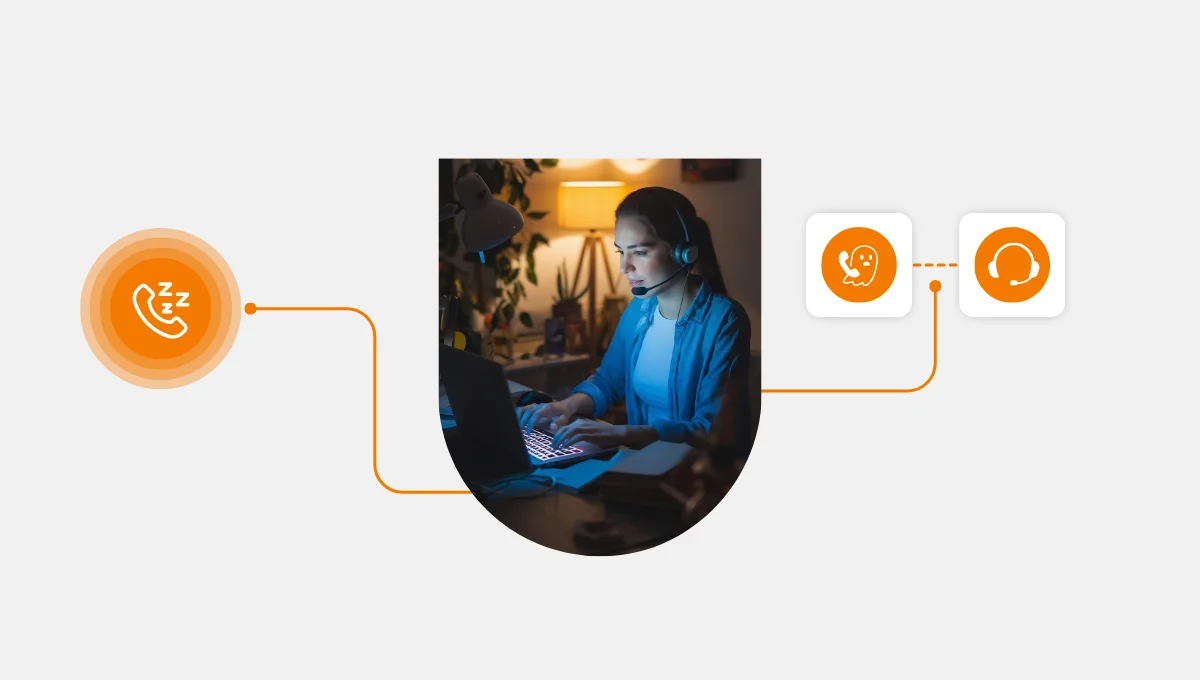
Call one: “What’s my order status?” Ninety seconds, script followed, and customer happy.
Call two: a customer whose refund failed twice, whose card was charged again, and who has already explained everything to an AI agent. Ten minutes. Lots of silence. One apology that wasn’t in the script.
Now score them on the same form. Call two loses points for handle time and script adherence. Call one wins.
In a hybrid operation, call one is increasingly handled by AI. Call two is what your people do all day. If your QA scorecard for complex calls is still the one you built for simple ones, it’s quietly punishing your best agents.
Let’s bust the myths keeping that scorecard alive.
Myth: “The Calls Are the Same, There Are Just Fewer of Them”
When AI takes over password resets and order-status questions, it doesn’t take a random slice of your volume. It takes the predictable, repetitive slice. What stays with humans is the rest: exceptions, escalations, emotional customers and problems spanning several systems.
The industry is reading it the same way. CX Today’s CCW Nashville 2026 takeaways state it plainly: “Agent roles are becoming more complex,” and agents “need stronger training, better context, and systems that support more complex work.”
In “Redesign Not Replace”, CX Today’s Francesca Roche points to Ingka Group, IKEA’s largest franchisee, which retrained 8,500 people “for more complex support and remote interior-design sales roles” instead of cutting them.
And a Gartner survey of 321 service leaders, reported by CX Magazine, found 85% are expanding human agent responsibilities as AI absorbs routine contact volume.
If the calls your agents handle have changed, the scorecard you use to judge them has to change too. The best place to start isn’t the scorecard itself, but the calls. Pull a sample of last month’s human-handled conversations and list what’s actually in them. That way, you’ll redesign for the work your agents have today, not the work you remember.

Myth: “Faster Is Always Better” (and Other Rules to Retire)
Speed and consistency made sense when most calls were simple. A quick, by-the-book answer was usually the right answer. But complex calls don’t work that way. The fastest ending isn’t always a real resolution, and a script written for routine questions can sound tone-deaf to a frustrated customer. That’s why two of the most familiar QA criteria tend to age worst once the easy calls leave.
- AHT targets on complex contacts. A short call isn’t a good call if the customer has to call back. On a contact that needs diagnosis, a tight handle-time target rewards agents for rushing to an ending, not for reaching a resolution.
- Rigid script adherence. Scripts work for predictable conversations. A customer on their third attempt to fix a billing error needs to hear “I can see what happened, let me fix it,” not the standard greeting.
That doesn’t mean dropping speed or compliance. Keep the mandatory parts of the script (verification, legal disclosures) as pass/fail items. Track AHT as an operational metric for workforce planning, not as a quality score. For a customer-side lens, effort beats minutes.
👉 Our piece on Customer Effort Score as the metric most teams miss explains why.
Myth: “Good Agents Just Follow the Process”
On complex calls, the process often is the problem. The skills that matter now look different, so your scorecard should name them.
- Diagnosis. Did the agent ask the right questions and find the real issue, not just the first symptom the customer mentioned?
- Ownership. Did they commit to an outcome (“I’ll call you back Thursday with the answer”) and avoid passing the customer along?
- De-escalation. Did they acknowledge the frustration, slow the conversation down, and bring it back to solutions?
- Use of AI-provided context. When a call arrives from the AI agent, did the agent use the history they were given, or make the customer repeat everything?
That fourth one is new, and it’s where hybrid operations break most often. If a call reached the agent with its full history and the customer still had to start over, that’s a quality failure, not a system quirk. We covered the handoff side in how smarter AI handoffs protect the hard conversations.
Write each new criterion as an observable behavior with an example of “meets” and “misses,” so evaluators score the same thing.
Myth: “Once the Scorecard Is Built, It’s Done”
Your business rules change: a new refund policy, a new compliance requirement. A static scorecard drifts quickly, and a manual team reviewing a small sample can’t recalibrate fast enough.
This is where AI scoring earns its place. With custom AI scoring prompts, you describe your own standard (what empathy sounds like in your operation, what a compliant disclosure must include) and apply it to every transcript. When the rule changes, you update the prompt instead of retraining evaluators.
A practical rhythm: review the scorecard every quarter, and immediately after any major policy change. Spot-check a set of AI-scored calls against human evaluators each time, so you know the scoring still matches your intent.
Treat the scorecard like a product, with owners, versions, and release notes for agents.
Build a QA Scorecard for Complex Calls That Fits Your Real Calls
So how do you score every complex call fairly, without hiring an army of evaluators?
CX Quality is built for exactly this.
- 100% evaluation with AI scoring: Assess every agent interaction against your own criteria, not a random sample.
- Custom AI scoring prompts: Teach the system your standards for empathy and compliance; it recalibrates as business rules change.
- Automatic transcription: Full coverage of voice and chat conversations.
- Root-cause analysis: Find the “why” behind performance and sentiment issues.
- Real-time smart alerts: Get notified about compliance risks and negative trends as they happen.
- Quality and Growth Scores: Measure excellence and progress, and track development over time.
- Smart coaching: Assign training modules to each agent’s specific skill gaps.
If you still run evaluation forms and call recordings, see how this builds on classic quality management software.
Your agents handle the hardest conversations in your business. Build a QA scorecard that fits your real calls with CX Quality. Book your demo today.
FAQ
Should AHT stay on the QA scorecard?
Mostly no. Keep it as an operational metric for staffing and forecasting, but don’t score complex contacts on speed. Judge them on resolution and the quality of the conversation.
How often should scorecards be reviewed?
At least quarterly, and right after any major policy, product, or compliance change. Each review should include a calibration check between AI scores and human evaluators.
How do we explain scorecard changes to agents?
Start with the why: their calls got harder, so the scorecard should too. Share “meets” and “misses” examples and allow a grace period before new scores count.