
Most conversations about AI in the contact center still revolve around one number: containment. How many calls did the bot resolve without a human? Or how many agent hours did that save?
Containment is a reasonable metric, but it hides the more important design question. The real test of an AI-powered contact center is not how much it automates. It is whether the right conversations reach the right person at the right moment, with full context attached.
In this article, we look at what a recent public-sector deployment reveals about that challenge, where human judgment still wins, and how AI Connector helps contact centers turn the AI-to-human handoff into a deliberate design decision rather than an afterthought.
Containment Is the Wrong Headline
A high containment rate looks great on a dashboard. But imagine two AI agents that both resolve 75% of incoming contacts. The first sends the remaining 25% to humans at random, after customers have repeated themselves three times.
The second identifies distressed, vulnerable, or high-value customers early and hands them over instantly, with the full conversation history and a summary already on the agent’s screen.
Both deployments report the same automation number. Only one of them protects your customer experience, your brand, and your compliance record.
This is why leading contact centers are shifting the question from “How much can AI handle?” to “Which conversations must AI recognize and release?”

What a Public-Safety Contact Center Teaches Every CX Team
A recent example from the UK makes the point clearly. As CX Today reported, Thames Valley Police and Hampshire and Isle of Wight Constabulary say their AI agent, Bobbi, now automates around 75% of public contacts. Yet the forces frame the real test differently: making sure the remaining 25%, the vulnerable and high-harm cases, reach a human operator on their 24/7 digital desk.
Few businesses handle police matters, but almost every contact center has its own version of that 25%:
- A banking customer who mentions financial hardship or bereavement
- A telecom subscriber disputing a bill for the third time this month
- An insurance policyholder calling right after an accident
- A healthcare patient who sounds confused or anxious
- A high-value B2B account threatening to cancel
In each case, a technically correct automated answer can still deliver the wrong customer experience. The cost of a mishandled conversation here is far higher than the cost of a few extra minutes of agent time.
Where Humans Still Win
The industry is converging on a clearer picture of when a human should take over. In a briefing published on October 6, TELUS Digital highlighted emotionally charged conversations, ambiguous account issues, and escalations where a customer has already worked through self-service without reaching a resolution. It also notes that once a customer has exhausted the bots, they need a live agent even if the issue is simple and they are calm.
That last point deserves attention. Customer frustration is cumulative. Every failed self-service attempt raises the stakes of the next interaction, so the AI-to-human handoff decision should account for the whole journey, not just the current message.
There is also a strategic warning in the market. CX Today recently contrasted OpenAI’s push toward always-on agents with Gartner’s view that 70% of enterprises deploying agentic AI this way will abandon it by 2028. The lesson for contact centers is not to slow down on AI. It is to design oversight and escalation into AI from day one.
Five Escalation Triggers Worth Building In
Well-designed AI-to-human handoffs rarely depend on a single signal. Most effective setups combine several:
- Sentiment and emotion. Rising frustration, distress, or anger detected in voice or text should lower the threshold for human takeover.
- Vulnerability and risk keywords. Mentions of illness, bereavement, financial hardship, fraud, legal action, or safety concerns should route to trained agents immediately.
- Repeat contact. A customer contacting you about the same issue for the second or third time is already at risk. Treat repeat contacts as priority escalations.
- Customer value and context. CRM data such as account tier, contract renewal dates, or open complaints can justify a faster route to a human.
- AI confidence and loop detection. If the AI agent is uncertain, keeps rephrasing, or the customer asks the same question twice, it is time to hand over.
How AI Connector Turns Handoffs Into a Design Decision
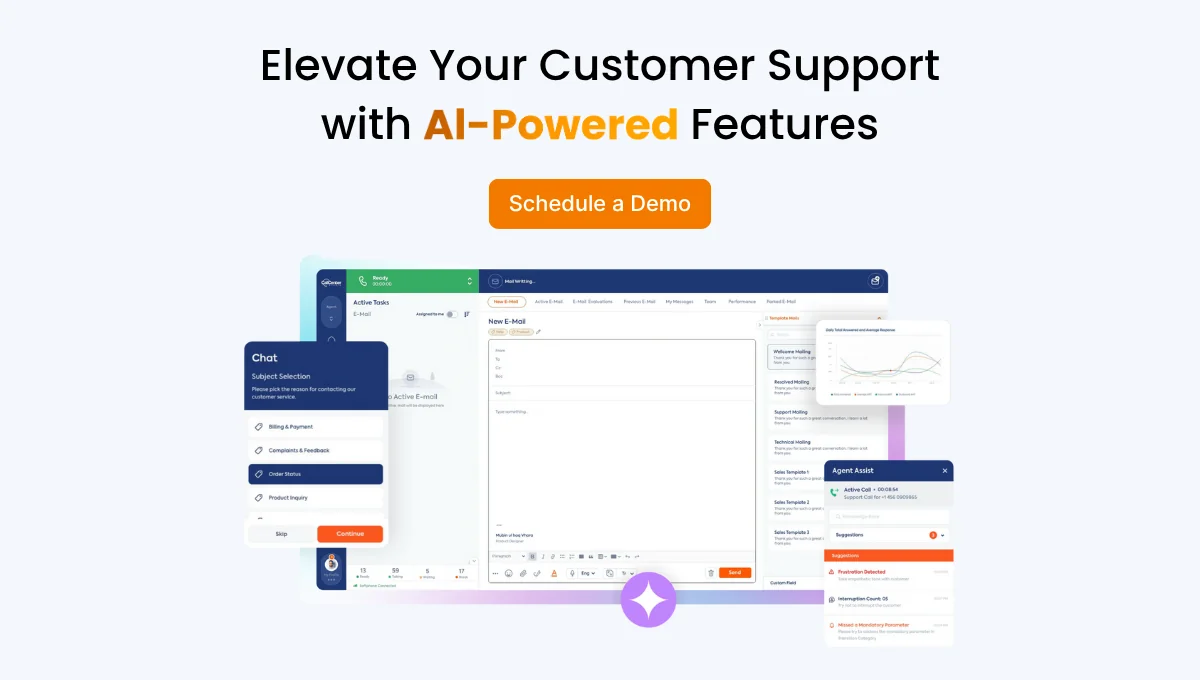
Rather than locking you into a single bot or a single AI model, AI Connector links the AI agents and virtual assistants you choose to routing, agent desktop, and omnichannel infrastructure. That connection is what makes intelligent handoffs possible.
With AI Connector in place, contact centers can:
- Let AI handle routine volume across voice and digital channels in a single omnichannel flow, including WhatsApp Business, while keeping the human team one step away.
- Define escalation rules centrally, so triggers such as sentiment, keywords, repeat contacts, or CRM attributes decide when a conversation moves to a person.
- Transfer context, not just the customer. The agent receives the conversation history and relevant data, so the customer never has to start over.
- Route to the right skill group, sending vulnerable customers to specially trained teams and high-value accounts to senior agents.
- Keep flexibility as AI evolves, switching or combining AI providers without rebuilding the contact center around them.
The result is an AI layer that knows its limits, which is exactly what customers, regulators, and contact center leaders want.
Treat Your AI Agent Like a New Hire
No contact center would put a new agent on the phones without training, supervision, and quality reviews. AI agents deserve the same discipline.
- Onboard it with clear boundaries. Document what the AI agent may resolve, what it must never attempt, and when it must hand over.
- Review its conversations. Combine AI Connector with CX Quality and CX Insights to analyze AI-handled interactions the same way you evaluate human ones.
- Coach it continuously. Use missed escalations and poor handoffs as training material to refine prompts, flows, and triggers.
- Give supervisors visibility. Supervisors should see AI and human workloads side by side and step in when needed.
Measure the Handoff, Not Just the Containment
If containment is the only KPI, AI agents will be tuned to hold on to conversations they should release. Balance it with metrics that reflect the quality of the AI-to-human handoff:
- Escalation accuracy: the share of escalated conversations that truly needed a human, and the share of contained ones that should have been escalated
- Time to human: how long a vulnerable or frustrated customer waits before reaching a person
- Context completeness: how often agents have to ask customers to repeat information
- Post-handoff resolution: first-contact resolution and CSAT for escalated conversations
- Repeat contacts after AI resolution: a direct signal of answers that only looked resolved
AI can and should handle a large share of contact center volume. But the conversations that define your reputation sit in the remaining minority: the anxious, the vulnerable, the frustrated, and the high-stakes. Designing for that minority is what separates responsible automation from risky automation.
Call Center Studio helps you combine the efficiency of AI agents with the judgment of human ones, and make sure every handoff happens at the right time, to the right person, with the full story attached.
Ready to design smarter AI handoffs? Contact us to see how AI Connector fits into your contact center.
FAQ
What is an AI-to-human handoff in a contact center?
An AI-to-human handoff is the moment an AI agent or chatbot transfers a customer conversation to a live agent. A good handoff happens at the right time, reaches the right skill group, and carries the full conversation history so the customer does not have to repeat themselves.
What is containment rate, and why isn’t it enough?
Containment rate is the share of customer contacts resolved by self-service or AI without reaching a human agent. It measures efficiency, but not quality. A conversation can count as contained even when the customer gives up or calls back later, so containment should be read alongside repeat contacts, CSAT, and escalation accuracy.
When should an AI agent transfer a call to a human agent?
An AI agent should escalate when it detects negative sentiment or distress, vulnerability or risk keywords, repeat contacts about the same issue, high-value or at-risk accounts, or its own low confidence. Customers who have already exhausted self-service options should also reach a live agent quickly.
How does AI Connector support AI-to-human handoffs?
Call Center Studio’s AI Connector links the AI agents and virtual assistants you choose to the contact center’s routing, agent desktop, and omnichannel infrastructure. This lets you define escalation rules centrally, route conversations to the right skill group, and pass full context to the agent at the moment of transfer.
How do you measure the quality of AI handoffs?
Useful metrics include escalation accuracy, time to human, context completeness, post-handoff resolution and CSAT, and repeat contacts after AI resolution. Together, they show whether your AI agents release the right conversations at the right time and improve the overall customer experience.