
An AI virtual agent, also called an Intelligent Virtual Agent (IVA), is an autonomous system that uses natural language understanding, reasoning, and live backend integrations to resolve customer requests across voice and chat channels without human intervention.
Unlike scripted chatbots, IVAs reason through multi-step problems, query live business systems, and complete transactions on their own. In 2026, these agentic systems have moved from experimental demos to practical tools that contact centers use to lower operational costs, reduce customer friction, and protect revenue. According to Gartner, agentic AI will autonomously resolve 80% of common customer service issues without human intervention by 2029, cutting operational costs by 30%.
Practical business leaders, CIOs, CXOs, and operations directors, are no longer asking what AI is. They want to know whether it is an overhyped demo or a working asset that delivers measurable results today. This guide explains how modern IVAs integrate with existing systems, how companies of different sizes deploy them, how the hybrid (human-in-the-loop) model works, and what it takes to run real-time Voice AI.
1. What Is an AI Virtual Agent? Chatbot vs IVA vs Voice AI
The terms “chatbot,” “intelligent virtual agent,” and “Voice AI” are often used interchangeably, but they describe very different levels of capability. The table below shows how they compare.
| Capability | Rule-Based Chatbot | AI Virtual Agent (IVA) | Voice AI Agent |
| Understands natural language | Limited | Yes | Yes |
| Reasons through multi-step tasks | No | Yes | Yes |
| Live system actions (CRM/ERP read & write) | No | Yes | Yes |
| Primary channel | Text only | Text + voice | Real-time voice |
| Handles interruptions (barge-in) | No | Partial | Yes |
| Best suited for | Simple FAQs | Complex transactions | Phone-first CX |
A rule-based chatbot follows fixed scripts and breaks as soon as a customer goes off-path. An IVA understands natural language and acts on live data. A Voice AI agent brings that same intelligence to the phone channel in real time. Most enterprise deployments combine all three, routing each interaction to the layer that resolves it fastest.
2. How Do AI Virtual Agents Integrate With Existing Systems?
Modern AI virtual agents integrate through an API-first architecture. Instead of replacing your CRM, ERP, or telephony, the IVA sits on top of your existing stack as an intelligent orchestration layer, connecting to your systems through secure APIs with no downtime.
The biggest internal roadblock to adopting next-generation AI is rarely a lack of interest; it is the fear of operational disruption. Many technology leaders assume that deploying a reasoning agent requires a multi-year project to rip out and replace their entire legacy environment, with broken database connections and lengthy downtime.
Modern cloud architecture challenges this assumption. Through an API-first approach, an advanced AI virtual agent does not replace your tech stack, it serves as a flexible orchestrator that sits directly on top of your existing ecosystem.
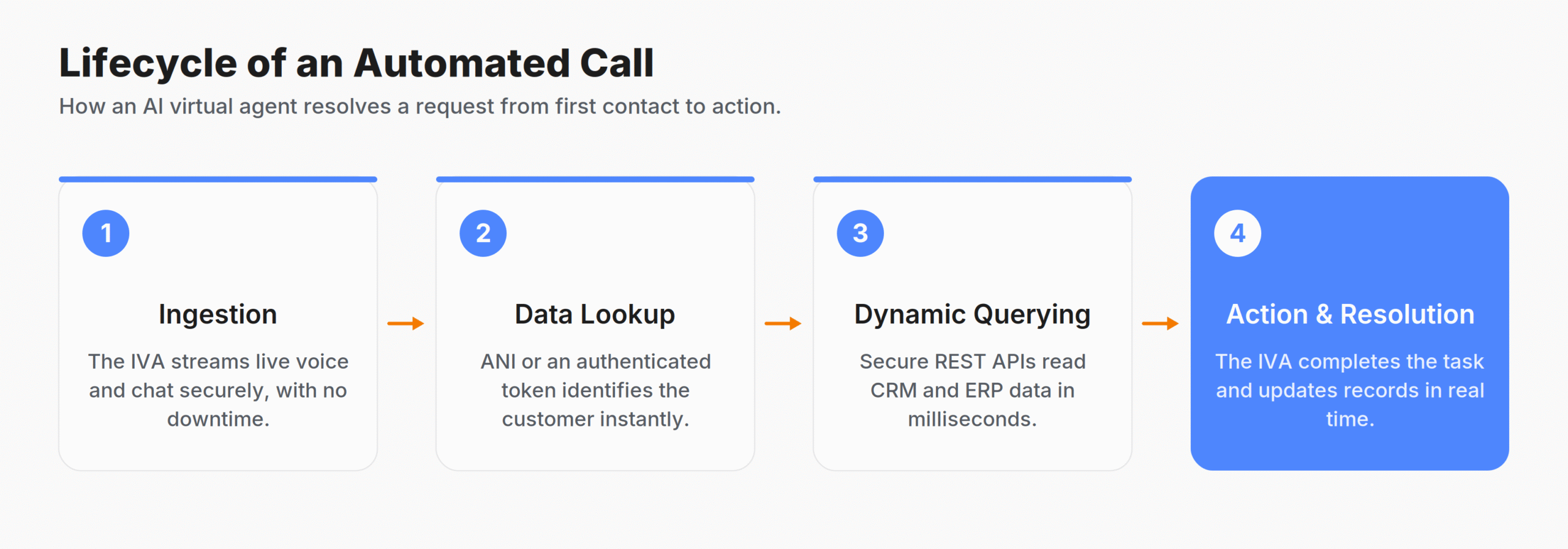
The Lifecycle of an Automated Call
- Ingestion point: Using cloud-hosted infrastructure, the IVA securely streams incoming voice and text data in real time, connecting with your existing communication lines without downtime for active operations.
- Data lookup: Once a call or chat enters the secure cloud tier, the agent initiates a data lookup using ANI (Automatic Number Identification) or authenticated user tokens.
- Dynamic querying: Instead of reading from a frozen script, the agent uses secure REST APIs to query your core systems within a few hundred milliseconds, checking CRMs like Salesforce, HubSpot, or Zoho for open tickets, purchase history, and subscription status, while querying ERP systems for live inventory or billing balances.
This deep integration shifts the AI from a simple talking machine into an operational asset. Because the agent has real-time read and write access to backend data, it can complete multi-turn tasks on its own. If a customer calls to change a delivery address, update a billing method, or process a subscription upgrade, the IVA performs the action directly in your databases, verifies the transaction, and updates the customer profile instantly, removing human effort from routine workflows.
3. How Do Companies of Different Sizes Deploy IVAs?
Deployment strategy depends on scale. Mid-market and high-growth brands use IVAs to absorb unpredictable volume spikes without adding headcount, while large enterprises use them to automate identity verification, compliance, and other repetitive steps that consume agent time.
An AI virtual agent is not a one-size-fits-all solution built only for corporate giants. It is elastic infrastructure that adapts to the operational pressure points of your scale, whether you are a high-growth e-commerce brand facing seasonal volatility or an enterprise handling thousands of compliance-heavy calls.
Mid-Market & High-Growth E-Commerce: Handling Volatility Without Adding Headcount
For fast-growing mid-market businesses, the main challenge is unpredictable spikes in contact volume. A successful campaign, a holiday rush, or a supply-chain delay can make queues skyrocket overnight. In a traditional setup, operations managers face two painful options: hire expensive temporary staff, or let hold times climb and damage brand loyalty.
With an IVA in place, mid-market brands can automate a large share of routine inbound traffic, order status lookups, returns, tracking numbers, and general FAQs. Gartner projects that by 2028, at least 70% of customers will use a conversational AI interface to start their service journey, making automation of routine inbound traffic a baseline expectation rather than a differentiator. Because the platform is cloud-hosted, it scales elastically: if inbound volume triples during a flash sale, the agent absorbs the surge without busy signals, long queues, or added staffing. Operating 24/7, this model lets companies grow support capacity while keeping operating expenditure (OpEx) flat.
Enterprise & Multi-Channel Operations: Removing Inertia and Securing Data at Scale
For large enterprises, banks, healthcare networks, and global logistics providers, the pain points differ. They do not struggle with basic scaling; they struggle with structural inertia and strict compliance demands. Live agents spend enormous amounts of time performing repetitive identification and verification steps before they can even address the customer’s real issue.
Enterprises deploy IVAs as an intelligent, secure gatekeeper for multi-channel operations:
- Identity verification: using advanced voice biometrics, the agent verifies a customer’s identity within seconds by analyzing their unique voiceprint during natural conversation.
- Regulatory compliance: while verifying identity, the system simultaneously handles compliance steps such as capturing GDPR, HIPAA, or regional privacy approvals.
By automating the first 30 to 60 seconds typically spent on identification and verification, the IVA removes a significant amount of manual talk time from every interaction.
4. What Is the Hybrid (Human-in-the-Loop) AI Model?
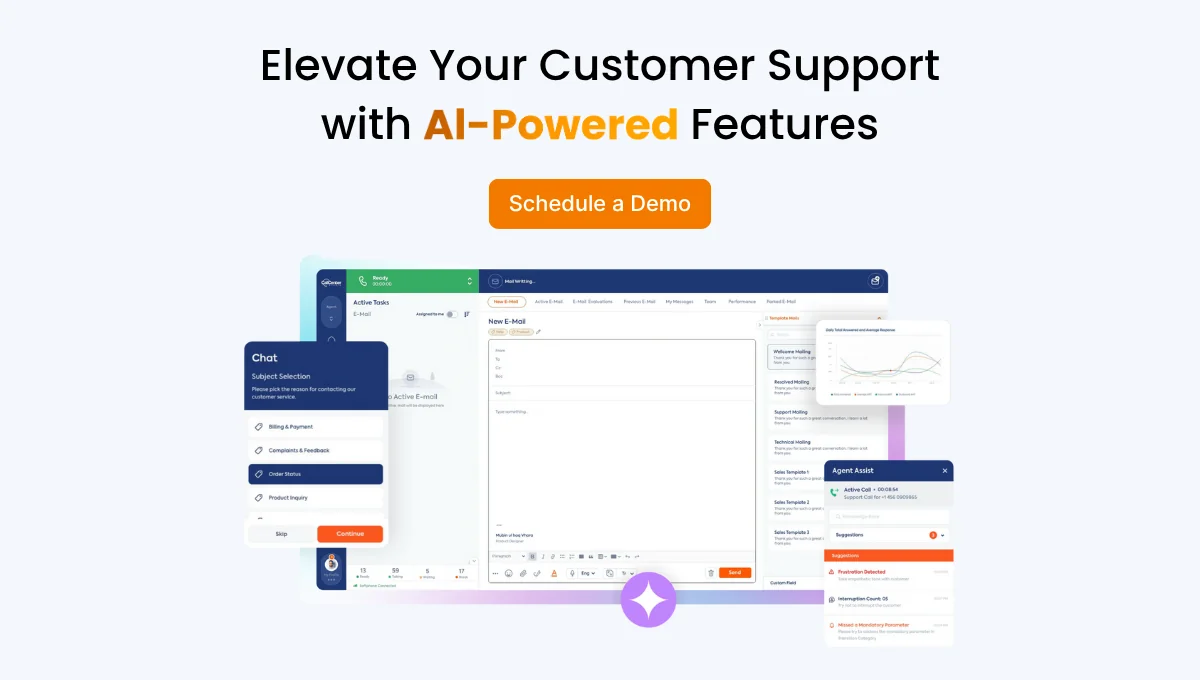
The hybrid (Human-in-the-Loop) model pairs an AI virtual agent with live agents. The IVA resolves routine interactions autonomously and, when it detects complexity or frustration, escalates to a human with full context: the transcript, verified identity, and recommended next actions.
The goal of deploying an autonomous agent is not to lock out human contact. Total automation with no escape hatch leads to customer alienation and high abandonment. The most effective frameworks use a collaborative model where AI amplifies human capability.
In this agent-assisted setup, the IVA sits on the frontline as a triage and resolution engine, performing two background tasks on every interaction:
- Intent recognition: understanding exactly what the customer wants.
- Real-time sentiment analysis: monitoring the customer’s emotional state by analyzing tone, vocabulary, and speech patterns.
If the request is a standard transaction, the IVA resolves it. But if the interaction involves high emotional complexity, an at-risk high-value account, or sudden frustration, the system triggers a seamless, context-rich escalation to a live agent.
This transfer is where legacy contact centers usually fail. In an unintegrated system, the customer is dropped back into a general queue and forced to repeat their story to an agent who has no context. In a modern hybrid setup, the live agent receives a unified data packet on their desktop the moment the call connects:
- The real-time interaction transcript
- The pre-verified customer identity
- The extracted intent
- AI-generated “next-best-action” solution prompts
The agent skips the introductory questions and continues exactly where the AI left off: “Hi Alex, I see you were talking with our virtual assistant about a billing mismatch on your recent invoice. I have it open right now, let’s fix it together.” This hand-off lowers Average Handling Time (AHT) and drives First Call Resolution (FCR) higher.
5. How Does Real-Time Voice AI Work in a Contact Center?
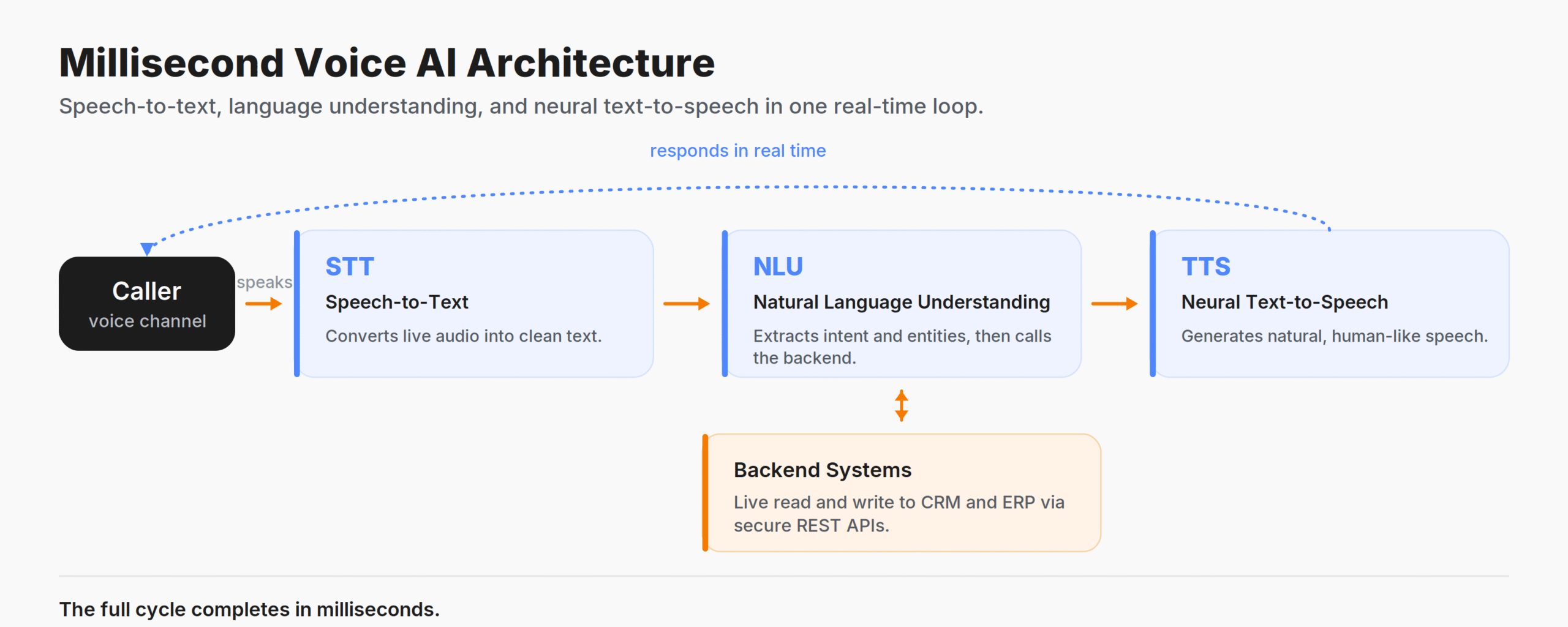
Real-time Voice AI works by orchestrating three layers (speech-to-text, natural language understanding, and neural text-to-speech) within milliseconds, so the system can listen, understand, query backend data, and respond without the silence that makes callers hang up.
Automating text-based chat is largely a solved problem, but the voice channel is where efficiency is won or lost. Text allows for latency; a customer accepts a short delay before a chat message appears. On a live phone call, latency is unacceptable. If a system takes more than about 1.5 seconds to respond, it creates a noticeable silence; the caller assumes the line dropped and hangs up.
The Millisecond Multi-Layer Architecture
To simulate a natural conversation, an enterprise-grade Voice AI platform orchestrates three core layers at once, completing the cycle in milliseconds:
- Real-time Speech-to-Text (STT): the moment audio streams through cloud-hosted SIP trunks, the STT layer converts acoustic signals into clean text, capturing diverse regional accents and filtering out background noise.
- Natural Language Understanding (NLU): this layer parses the full sentence to extract intent and key entities (account numbers, dates) while calling backend APIs to pull required context.
- Neural Text-to-Speech (TTS): modern neural TTS engines generate realistic, human-like speech with natural intonation, streaming audio back to the caller seamlessly.
Why Interruptibility (Barge-In) Matters
Beyond speed, an advanced Voice AI platform needs one critical behavior: interruptibility, also called barge-in management. In real conversations, people do not wait for a system to finish a long sentence.
If the agent is saying, “Welcome back, I can help with billing, shipping, or account settings…” and the customer cuts in with “My card was stolen, cancel it now,” the system must react instantly. It detects the incoming speech, halts its own audio, clears its output queue, processes the urgent input, and pivots the conversation without missing a beat. This is what separates true conversational intelligence from an advanced answering machine.
6. How Affordable Is Modern Voice AI? Democratizing Enterprise-Grade AI
Modern Voice AI no longer requires a tech-giant budget. Cloud-native platforms package speech recognition, language understanding, and neural voice into plug-and-play services billed on a pay-as-you-go model, so businesses pay only for what they use.
When leaders look at next-generation agentic AI, they often assume it requires a Silicon Valley budget: an army of data scientists, custom language models built from scratch, and millions in development. This is a misconception.
In 2026, cloud-native contact center platforms have democratized this capability. You do not need a dedicated AI research lab or months of custom coding to activate an advanced AI virtual agent; modern platforms package these complex capabilities into accessible, plug-and-play ecosystems.
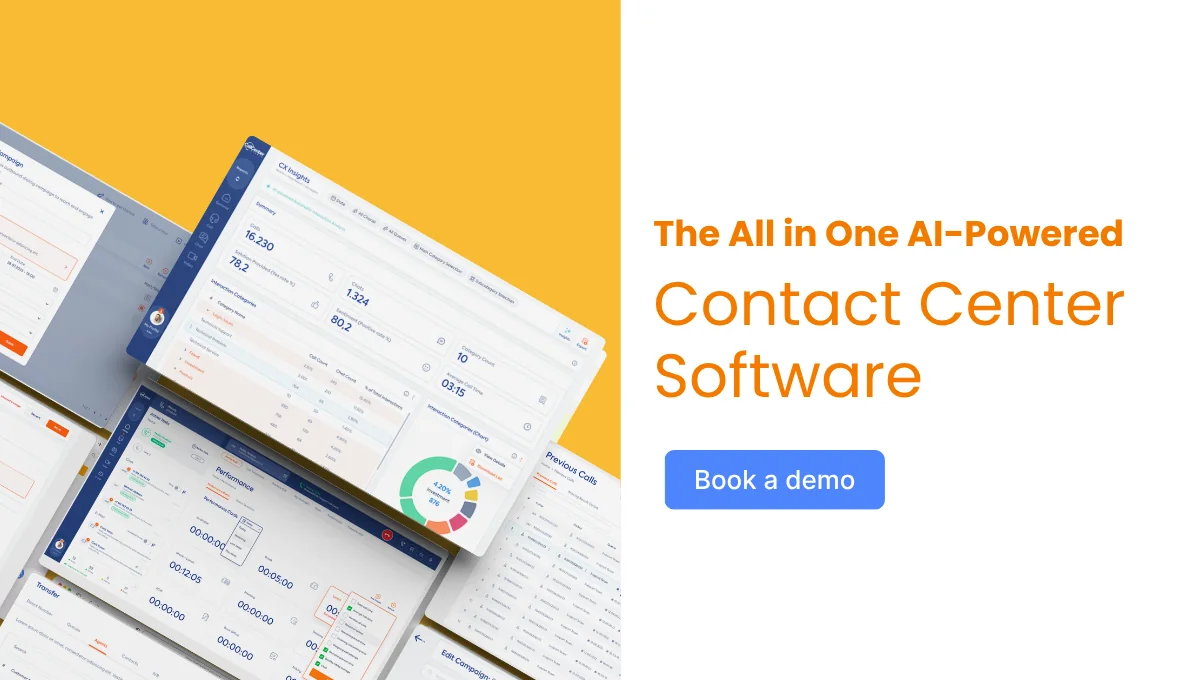
By using a cloud-native platform like Call Center Studio, businesses bypass the heavy engineering work entirely. Instead of large upfront licensing fees or on-premise infrastructure, they operate on a flexible, utility-based OpEx model and pay only for the bandwidth and processing they consume. An autonomous, 24/7 customer experience is no longer reserved for tech giants; it is an accessible reality for any forward-thinking brand.
7. Enterprise Readiness Checklist
Moving from static chatbots to autonomous Voice AI is a strategic evolution. To deploy AI virtual agents without technical friction, review this foundational infrastructure checklist:
- Cloud-native inbound telephony: Your voice channels run on a modern cloud ecosystem rather than legacy on-premise PBX hardware, enabling real-time API data streaming.
- Clean, accessible API layers: Your CRM, ERP, and internal databases expose well-documented, secure REST APIs so the IVA can read and write within milliseconds.
- High-volume task isolation: You have audited your support queues and isolated your highest-volume, routine transactions (shipment tracking, password resets, bill payments) as initial AI use cases.
- Security and masking compliance: Your framework supports DTMF masking (audio stripping) and automated PII redaction to stay compliant with GDPR, HIPAA, and PCI-DSS.
Don’t let rigid phone menus and legacy chat tools frustrate customers and drive up operational overhead. Step into modern, automated customer experience with an AI-native cloud platform built for scale.
Ready to see an AI virtual agent adapt to your business rules? Book your free live demo with Call Center Studio and see how accessible next-generation Voice AI can be.
Frequently Asked Questions
What is an AI virtual agent?
An AI virtual agent (or Intelligent Virtual Agent, IVA) is an autonomous system that understands natural language, reasons through requests, and acts on live business data to resolve customer interactions across voice and chat, without human intervention. Unlike scripted chatbots, it can complete multi-step tasks such as updating billing or processing an order on its own.
What is the difference between a chatbot and an AI virtual agent?
A rule-based chatbot follows fixed scripts and handles only predictable, simple questions. An AI virtual agent understands natural language, queries live systems like your CRM and ERP, and completes transactions autonomously across both text and voice. In short, a chatbot answers; an IVA acts.
How long does it take to deploy an AI virtual agent?
Unlike legacy on-premise setups that require months of custom coding, cloud-native platforms let you deploy functional voice and chat workflows within days or weeks using pre-built integrations and native CRM connectors.
Will deploying a Voice AI agent disrupt our existing telephony or CRM?
No. Through an API-first framework, modern IVAs act as an intelligent layer on top of your current ecosystem. They integrate with platforms like Salesforce, Zoho, or internal ERPs via secure REST APIs without operational downtime.
How does Voice AI handle compliance regulations like GDPR, HIPAA, or PCI-DSS?
Enterprise-grade cloud platforms apply strict security protocols, including real-time PII redaction, data encryption, and DTMF masking (audio stripping for payment details), to keep every interaction compliant with GDPR, HIPAA, and PCI-DSS.
What happens if the AI virtual agent cannot understand a request?
The system uses a hybrid (Human-in-the-Loop) model. If it detects high frustration or a complex issue through real-time sentiment analysis, it performs a seamless, context-rich hand-off to a live agent, passing along the full transcript and verified identity so the customer never repeats themselves.
What is barge-in (interruptibility) in Voice AI?
Barge-in, or interruptibility, is the ability of a Voice AI agent to stop talking the instant a customer speaks over it. The system halts its audio, clears its output, processes the new request, and pivots immediately, mirroring natural human conversation instead of forcing the caller to wait.
How much does an AI voice agent cost?
Cloud-native platforms typically use a pay-as-you-go (OpEx) model, so you pay only for the bandwidth and processing you consume rather than large upfront licensing fees or on-premise hardware. This makes enterprise-grade Voice AI accessible to mid-market and growing businesses, not just large enterprises.