

In 2026, the phone channel remains the ultimate battleground for customer loyalty. While modern conversational voice systems act as massive revenue drivers, obsolete systems silently kill operational efficiency.
Consider the stark reality of today’s customer experience landscape:
- 41% of consumers have stopped doing business with a brand entirely due to a poor IVR experience.
- $3 trillion in sales are put at risk globally by organizations due to bad customer experiences that force users to cut back or halt spending.
To eliminate this friction and reclaim at-risk revenue, enterprises must deploy intelligent, data-driven voice architectures. This comprehensive guide provides the exact technical and strategic blueprint required to navigate this architectural shift.
In this guide, you’ll find:
- The 2026 Benchmark: An overview of what next-generation, AI-native IVR actually means today.
- The Technical Engine: A deep dive into the four core components processing human speech in real time (SIP, STT, NLU, and TTS).
- Enterprise Architecture: How to connect your voice tier directly with your CRM, ERP, and core database layers.
- Engineering Challenges: Real-world solutions for API latency, context fragmentation, and strict PCI-DSS or GDPR security compliance.
- The Ideal Flow Blueprint: A step-by-step framework for designing a conversational journey that balances self-service automation with context-rich, skills-based routing.
- Operational KPIs: The essential analytics (Containment, AHT, and FCR) you need to track to measure true ROI.
Let’s dive in by redefining the baseline of modern voice technology.

What is a Modern IVR? (The 2026 Benchmark)
In 2026, a modern Interactive Voice Response (IVR) system is defined as an AI-native, cloud-based conversational gateway that serves as the front door to your enterprise customer experience.
Instead of forcing users to adapt to rigid machine logic (“Press 1 for Sales”), a modern IVR adapts entirely to human logic. On the one hand, it leverages Large Language Models (LLMs) and advanced Natural Language Understanding (NLU) to conduct fluid, contextual, and human-like phone conversations.
On the other hand, this next-generation architecture is fully capable of authenticating users and resolving complex, non-linear issues entirely through automated self-service, completely rendering old touch-tone menus obsolete.
How the Most Advanced IVR Systems Work
Now that we have defined this intelligent 2026 benchmark, the logical next question is: How does this system actually process human speech in real time?
When a company deploys a cutting-edge IVR system today, it does not rely on legacy copper wires or simple, pre-recorded audio scripts. Instead, it operates through a synchronous, milliseconds-fast orchestration of four core components, building on top of each other to simulate a real human conversation.
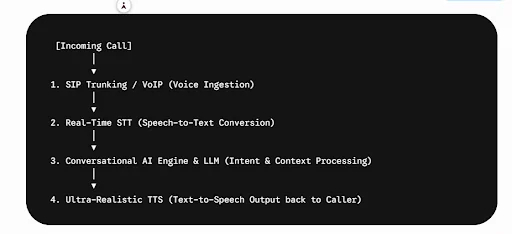
1. SIP Trunking & Cloud Ingestion
Traditional copper-wire telephone lines (PSTN) are virtually obsolete for enterprise operations. Modern hosted IVR platforms rely entirely on VoIP (Voice over Internet Protocol) and SIP (Session Initiation Protocol) Trunking. In addition to lowering telecom costs, the call enters through cloud-hosted SIP trunks, streaming voice calls securely over the internet to handle massive call volumes simultaneously without busy signals, while offering infinite scalability.
2. Real-Time Speech-to-Text (STT)
The moment the call is ingested via SIP, the next layer instantly kicks in. As the customer speaks, an advanced speech recognition and STT engine converts their voice into unstructured text data in real time. Furthermore, this system is trained to accurately capture diverse nuances, regional accents, and emotional sentiment under fluctuating background noise conditions.
3. Conversational AI & NLU Engine
Once the voice data is converted to text, it must be interpreted. This text is instantly fed into a fine-tuned LLM. Along with analyzing the customer’s intent (What do they want?), the system simultaneously extracts key entities (e.g., account numbers, full names, dates). At the same time, it pings the company’s internal databases via secure APIs to understand the broader context of the interaction.
4. Ultra-Realistic Text-to-Speech (TTS)
Finally, after the engine determines the appropriate response, the text must be translated back into voice. A neural TTS engine generates a natural, highly human-like voice response. Complete with proper breathing, authentic intonation, and contextual pauses, the system streams the audio back to the caller seamlessly, eliminating the robotic drone of the past.
Having established how an individual call flows through these four technical layers, now we must look at how this data layer connects to the rest of your organization.
How an IVR Fits Into Your Enterprise Tech Stack
An IVR cannot live on an island; it requires the immediate support of your broader ecosystem. To maximize operational efficiency and customer lifetime value, it must be deeply integrated across your company’s existing digital infrastructure. A modern cloud IVR deployment connects seamlessly across three primary layers:
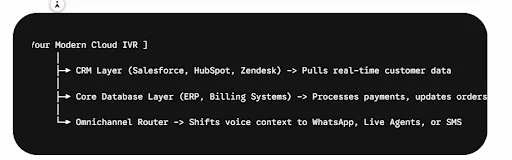
The CRM Layer
The moment a call hits the IVR, the system uses Automatic Number Identification (ANI)—the commercial equivalent of caller ID—to instantly look up the caller’s phone number against CRM environments like Salesforce, HubSpot, or Zoho, pulling up active subscriptions, recent open support tickets, and purchase history before the automated voice even delivers a greeting.
The Core Database Layer (ERP & Billing)
In addition to checking CRM history, a truly useful IVR must be able to perform backend tasks. To allow customers to execute advanced self-service actions—such as checking order shipment status, resetting account credentials, or processing secure payments—the IVR communicates directly with your backend database or enterprise resource planning (ERP) systems via secure REST APIs.
The Omnichannel Routing Engine
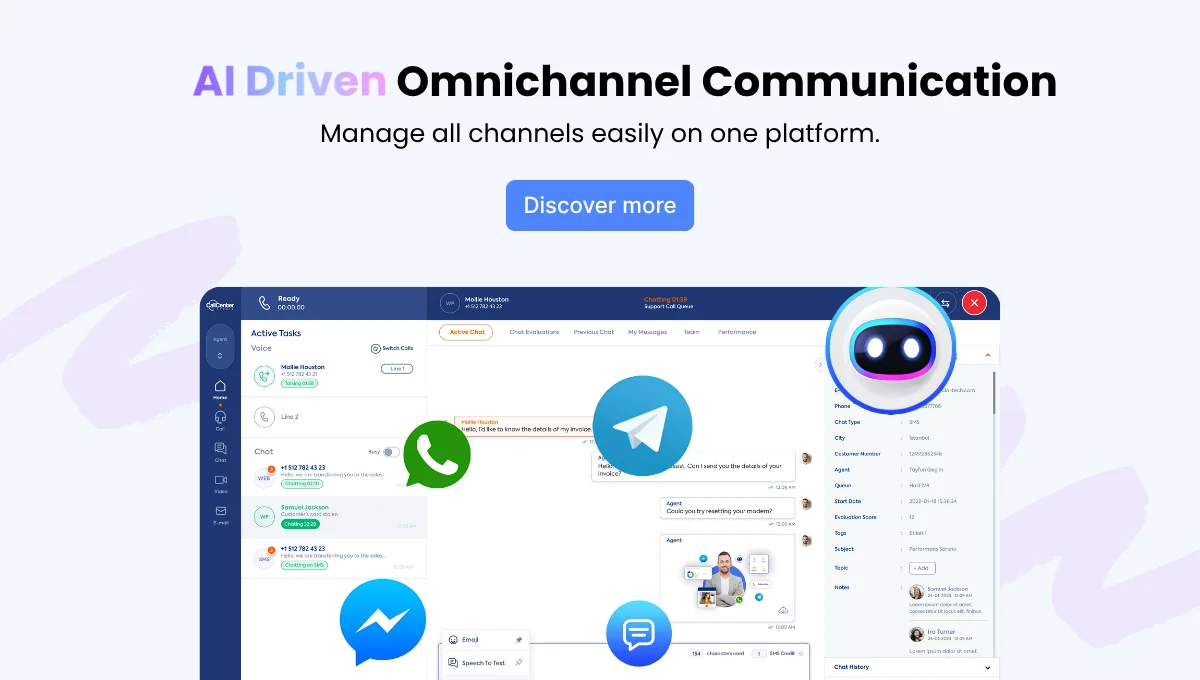
On top of databases and CRMs, the IVR must also bridge the gap with your human workforce. If an issue is too complex for AI self-service, the IVR packages the entire interaction transcript, data context, and customer history. Concurrently, it smoothly routes the call to a live agent via skills-based routing or offers to shift the conversation to a digital tier like WhatsApp, Live Chat, or SMS.
3 Biggest IVR Integration Challenges & How to Solve Them
While connecting the system to your CRM, databases, and human agents sounds ideal on paper, putting this architecture into practice introduces real engineering hurdles. Integrating an advanced conversational IVR into an established business structure is where teams encounter technical friction.
Below are the most critical integration challenges faced today, along with their strategic technical solutions to ensure your deployment remains flawless:
Challenge 1: API Latency & Delayed Responses
If your IVR takes more than 1.5 to 2 seconds to fetch data from your legacy CRM or internal database, a deadly silence occurs on the phone line. Consequently, the customer thinks the call dropped and hangs up.
- The Solution: Implement aggressive database caching for frequent requests and build asynchronous API webhooks. While the system fetches data, the IVR should utilize “conversational fillers” (e.g., “Let me look up those account details for you real quick…”) generated by the neural voice engine to keep the user naturally engaged and eliminate dead air.
Challenge 2: Context Fragmentation (The “Agent Amnesia”)
Another major roadblock occurs during human handoffs. A customer spends two minutes explaining a highly specific issue to an AI IVR, but when they get transferred to a live human agent, the agent asks: “How can I help you today?” This repetition is a primary driver of customer abandonment.
- The Solution: Deploy unified SIP Refer or User-to-User Information (UUI) data transfer protocols. As a result, the real-time AI chat transcript, verified customer ID, and calculated intent are pushed directly onto the live agent’s desktop dashboard simultaneously with the phone ring.
Challenge 3: Security & Data Privacy Compliance (PCI-DSS & GDPR)
Beyond latency and context loss, companies must also protect the sensitive information being transferred. When customers state their credit card numbers, medical data, or passwords to an AI-powered voice system, that data flows through cloud servers, risking severe compliance violations.
- The Solution: Use advanced DTMF Masking (Audio Stripping) and automatic PII (Personally Identifiable Information) redaction. When a customer speaks or types a credit card number, the IVR strips that specific audio packet from the call logs and encrypts it instantly before sending it to the payment gateway.
In addition to payment safety, ensuring HIPAA & GDPR Readiness requires that voice logs, customer data, and biometrics are encrypted both in transit and at rest, backed by strict data retention schedules to comply with international privacy regulations.
Solving these security and engineering hurdles depends heavily on the foundational framework your telephony sits on. This brings us to a critical crossroads: choosing the right infrastructure.
Comparative Architecture: Key Features & Technologies of Next-Gen IVRs
When evaluating how to deploy your voice channels, the difference between rigid legacy hardware and modern cloud ecosystems is stark:
| Feature | Legacy On-Premise IVR | Modern Cloud IVR (IVRaaS) |
| Infrastructure | Physical servers, complex PBX hardware | 100% Cloud-hosted |
| Upfront Cost | Very High capital expenditure (CapEx) | Low, predictable subscription fee (OpEx) |
| Scalability | Hard; requires purchasing physical lines | Instant; scales dynamically based on traffic |
| Maintenance | Dedicated internal IT team required | Handled fully by the cloud provider |
| AI Integrations | Complex, requires custom middleware | Native, API-driven plugins & LLM support |
Ultimately, Cloud IVR has won the market simply because this technology allows organizations to deploy updates globally in minutes. In addition to rapid deployment, it lets you integrate instantly with core CRM platforms and dynamically scale capacity up or down depending on seasonal call volumes.
Once you make the leap to a cloud-based infrastructure, a whole new suite of operational capabilities becomes accessible. The next step is to evaluate modern IVR software solutions to deliver a truly competitive customer experience. Be sure that your chosen platform must integrate several non-negotiable technologies:
- Conversational AI & NLU: Allows customers to speak naturally (e.g., “I’m calling to check if my blue shoes shipped yet”) instead of forcing them to listen to a rigid list of robotic options.
- Visual IVR: Extends the voice experience to a digital screen. Concurrently, callers on smartphones can opt to receive a secure text link that opens a responsive visual menu to fill out forms or view rich media.
- Voice Biometrics (Authentication): Eliminates the tedious process of asking for passwords. Instead, the IVR securely verifies identity using the caller’s unique voiceprint.
- Dynamic Personalization: If a customer has an open, overdue invoice, the IVR bypasses the standard menu entirely and greets them with: “Hi Alex, are you calling to make a payment on your recent invoice?”
- Omnichannel Continuity: If a customer transitions from the IVR to a live agent, or from a web chat to a phone call, all data and context follow them seamlessly so they never have to repeat themselves.
Step-by-Step Guide to Designing an Ideal IVR Flow
Equipped with these advanced cloud features, you can now orchestrate them into a seamless customer journey. A poorly designed IVR flow frustrates users and damages brand loyalty. Creating an optimal conversational flow means abandoning rigid decision trees and embracing a dynamic, data-driven journey.
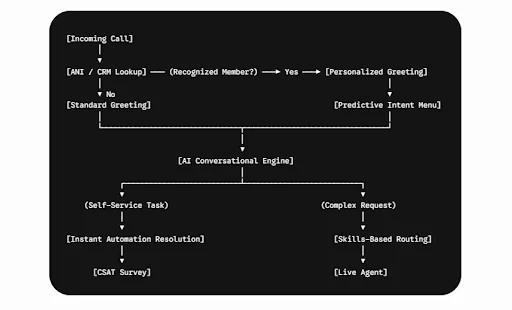
Below is the blueprint of a state-of-the-art conversational IVR workflow, showcasing how an incoming call transitions smoothly from automated verification to ultimate resolution:
Deconstructing the Ideal IVR Flow
To build an inbound call center voice channel that achieves high resolution rates without alienating users, your architecture must transition through four distinct phases, step-by-step:
Phase 1: Identification & Greeting
The moment a call hits your system, the IVR works silently before a single word is spoken. The technical engine captures the caller’s phone number via ANI and pings your CRM database via a rapid API lookup.
- The Personalized Path (Recognized Customer): If the phone number matches an existing profile, the IVR completely skips generic marketing fluff and triggers a personalized greeting using a realistic neural voice: “Hi Alex, welcome back to Acme Corp. Are you calling about the premium subscription payment you initiated yesterday?”
- The Standard Path (Unknown Caller): On the other hand, if the number is not recognized, the system falls back to a clean, brief standard greeting, instantly moving the caller to open-ended intent gathering.
Phase 2: Open-Ended Intent Gathering (AI Conversational Engine)
Following a tailored greeting, the system shifts into listening mode. Instead of forcing a user to listen to a laundry list of options, the modern IVR relies on Natural Language Understanding (NLU) to handle open prompt fields. The goal is to let the user state their issue in their own words by asking a simple, direct question: “How can I help you today?”
As the customer speaks, the underlying AI engine filters out filler words, assesses caller sentiment (detecting frustration or urgency), and identifies core intents and entities (e.g., Intent: Cancel Subscription, Entity: Account Number 9876).
Phase 3: The Fork in the Road (Automation vs. Escalation)
Once the AI recognizes the intent, the workflow dynamically splits into two main tracks based on the complexity of the request:
- Track A: Self-Service Automation: If the intent is a routine transactional task (such as checking a balance, updating an order, or resetting a password), the IVR handles it autonomously. It calls the necessary backend APIs, securely updates the systems, confirms the resolution with the caller, and seamlessly routes them to a brief CSAT survey before ending the call.
- Track B: Live Agent Escalation: However, if the request involves high emotional complexity, critical account issues, or an explicit request for human help, the system recognizes that automation is no longer viable and initiates a transfer.
Phase 4: The Role of Context-Rich Skills-Based Routing
When escalation becomes necessary, getting the caller to the right place quickly is the core metric of a high-performing inbound call center infrastructure. To achieve this operational success and minimize customer drop-off, enterprises require a highly orchestrated skills-based routing framework:
- Automatic Call Distribution (ACD): The core telephony software engine that works hand-in-hand with the IVR. Once the IVR gathers the caller’s intent, the ACD distributes the call to the correct department based on pre-defined corporate routing rules.
- Skills-Based Routing: Simultaneously, the IVR identifies the specific problem (e.g., a complex database bug) and searches the database for an available live agent who holds the exact certification, language proficiency, or skill set required to solve that issue, rather than just routing blindly to the next free agent in line.
- Queue Callbacks (Virtual Queuing): Along with skills matching, advanced IVRs track estimated wait times. If the wait exceeds a certain threshold, the system offers an automated callback: “Our current wait time is 15 minutes. Press 1 to keep your place in line, and we will call you back when an agent is ready.”
Core Principles for Tuning Your Flow
A well-designed Interactive Voice Response (IVR) system streamlines service, reduces operational costs, and empowers customers to resolve issues faster.
However, if your IVR is causing more frustration than efficiency, it’s time to rethink the design. When adapting this prose blueprint to your specific business rules, always enforce four golden rules to ensure the journey remains fluid:
- Keep the Greeting Brief: Avoid lengthy marketing pitches. Welcome the customer and get straight to the point. Alongside this brevity, never offer more than 3 or 4 choices at a single level if using an informational menu. Humans struggle to remember more options than that while listening.
- Provide a Clear Escape Hatch (The Golden Gate): Always provide an explicit verbal escape hatch. If a customer says “agent” or “human” at any stage, route them out of the automated flow immediately to prevent abandonment.
- State Actions Before Numbers (For DTMF Fallbacks): If a customer is in a noisy environment and has to fall back to using their phone keypad, always state the action before the number key. For example, use “For Billing, press 2” instead of “Press 2 for Billing” (as the user often forgets what the digit 2 was for by the end of the sentence).
- Deploy Conversational Fillers to Mask Latency: If an API lookup takes longer than 1 second, program the neural voice engine to say natural phrases like, “Let me grab those account details for you real quick…” to eliminate dead air and lower drop-off rates.
Essential IVR Metrics & Analytics to Track
With a perfectly optimized flow up and running, you need a mathematical framework to evaluate its day-to-day performance.
Implementing a modern Cloud IVR yields massive, measurable returns for both operational efficiency and customer retention, which can be measured through these core Key Performance Indicators (KPIs):
- IVR Containment Rate: The percentage of inbound calls that are completely resolved within the IVR self-service environment without requiring human agent intervention. Higher containment directly correlates with lower operational overhead.
- IVR Abandonment Rate: The percentage of callers who hang up while interacting with the IVR menus. A high rate indicates confusing conversational flows or excessive menu options.
- Zero-Out Rate: The frequency with which callers immediately press “0” or demand an agent to bypass your automated system entirely, signaling a lack of consumer trust in the prompt architecture.
- Customer Satisfaction (CSAT): Post-call automated IVR surveys that measure how happy the customer was with their automated or agent-assisted experience, collected immediately while the interaction is fresh.
- First Call Resolution (FCR): By accurately identifying customer intent through AI, callers are paired with the perfect resource on the first attempt, causing FCR metrics to skyrocket.
- Average Handling Time (AHT): Because the IVR handles the tedious identification, verification, and intent-gathering phases, live agents save 30 to 60 seconds of manual talk time per call, leading to a drastic reduction in overall AHT.
- 24/7/365 Availability: Routine tasks like checking account balances or confirming appointments can be fully automated via self-service, completely eliminating the need for expensive night-shift staffing.
- Lower Cost Per Contact: A self-service IVR interaction costs pennies compared to the cost of a live agent’s time, significantly driving down overall operational expenditures.
Tracking these performance metrics over time will make one thing clear: the future belongs to fully automated voice intelligence.
Consequently, brands that adopt sophisticated, AI-driven Cloud IVR platforms today will completely dominate customer satisfaction metrics moving forward.
Are You Ready to Launch an Intelligent Cloud IVR for 2026?
Don’t let rigid phone systems frustrate your customers and inflate your operational costs.
Step into the future of customer experience with our state-of-the-art, AI-powered Cloud IVR platform.
Book Your Free Live Demo Today and see how smart your voice channel can truly be!