
Finding Balance Behind the Screen: Small Scientific Steps to Protect Your Mental Health at Work
For the customer service professional, the “office” is no longer a place you leave at 5:00 PM. It’s a glowing rectangle that follows you into the kitchen, the bedroom, and occasionally the bathroom. We call it “availability,” though it often feels more like “hostage status.”
This “always on” style creates fatigue, burnout, and even physical health problems in the long run.
Ultimately, as a customer service specialist, protecting your mental health at work is a necessity. And the good news is you don’t need a grand gesture or a month-long sabbatical to reset. Real resilience is built in the small steps you take between every ticket, every call, and every login.
Let’s dive into these scientific micro-habits.
1. How should you start your morning before a shift? (The Morning Foundation)
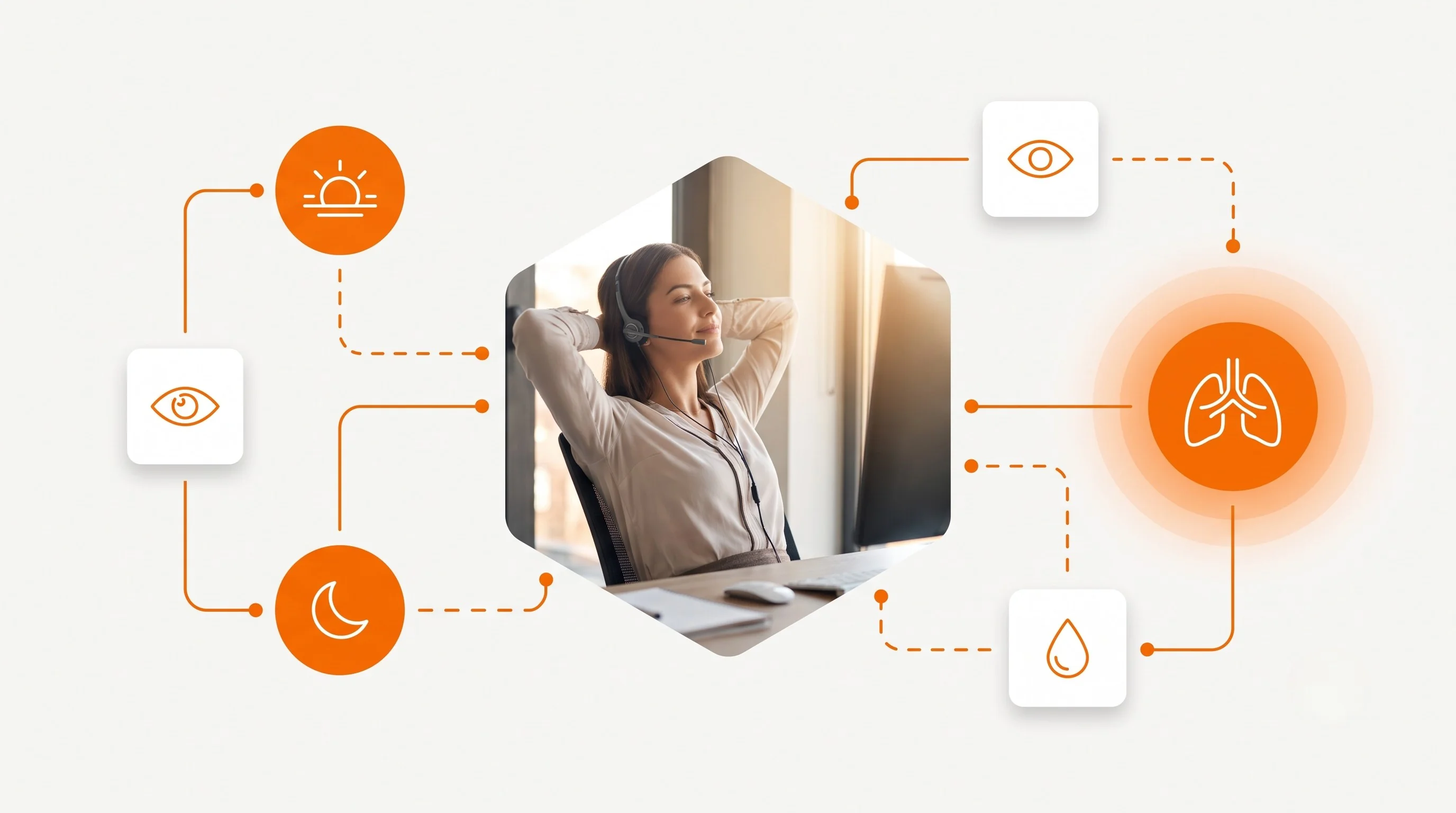
The most critical part of protecting your mental health at work happens before you even log in. Scientists emphasize the importance of setting your circadian clock to manage cortisol and melatonin.
- View Sunlight: Within 30–60 minutes of waking, get 5–10 minutes of direct sunlight. This triggers a timed cortisol pulse that increases alertness and sets a timer for sleep later that night.
- Delay Caffeine: Wait 90–120 minutes after waking before your first cup of coffee. This allows adenosine (the chemical that makes you sleepy) to clear out naturally, preventing the “afternoon crash” during your peak ticket-handling hours.
📚 A study on caffeine and adenosine receptors suggests that delaying intake can reduce the “afternoon slump” by up to 30%, as it prevents the buildup of sleep pressure that occurs when caffeine is consumed immediately upon waking. Source
Small Step: If you start work early, use a high-intensity 10,000 lux light box at your desk to simulate the morning sun.
2. Leverage Visual Cues for Focus (Digital Wellness)
The way you use your eyes directly impacts your brain’s level of alertness or calm.
- The 20-20-20 Rule with a Twist: Every 20 minutes, look at something 20 feet away for 20 seconds. Panoramic vision—purposely softening your gaze to see the periphery of the room—physically relaxes the muscles in the eyes and sends a signal to the brain to de-stress.
📚 Digital eye strain (Computer Vision Syndrome) affects roughly 50% to 90% of computer workers. Implementing the 20-20-20 rule has been shown to reduce reported symptoms of eye strain and headaches by nearly 40%. Source
- Screen Height & Alertness: There is a neural link between eye position and alertness. Looking up (placing your monitor slightly above eye level) triggers the brain’s “alert” centers. Looking down (at a laptop on your lap) triggers the “calm/sleep” centers.
Small Step: Use ergonomics to ensure your monitor is at or slightly above eye level to maintain high energy during long shifts.
3. How do you calm down between difficult calls?
Between intense calls or difficult tickets, you need a way to offload stress instantly. Scientists frequently advocate for the Physiological Sigh, which is one of the fastest biological ways to lower your heart rate.
- Inhale deeply through the nose.
- Take a second, shorter “pop” of air at the very top to fully inflate the alveoli in your lungs.
- Exhale slowly through the mouth until your lungs are empty.
Small Step: Perform 2–3 of these sighs after a stressful interaction to prevent “stress stacking” throughout the day.
4. Temperature Regulation for Cognitive Performance
Your brain’s ability to focus is closely tied to your body’s core temperature. If you feel “brain fog” mid-afternoon, it might be a temperature issue.
- Cooling the Palms: The palms of your hands act as “thermal portals.” If you feel overheated or sluggish, running cold water over your wrists or holding a cold drink can rapidly cool your core and restore mental clarity. Research shows that maintaining an optimal core temperature can prevent a 15–20% drop in productivity. Source
Small Step: Keep a cold water bottle at your desk—not just for hydration, but to use as a quick “thermal reset” for your nervous system.
5. Non-Sleep Deep Rest (NSDR) for Mid-Day Recovery
In a high-pressure contact center environment, a 20-minute nap is rarely possible. However, NSDR (also known as Yoga Nidra) is a protocol recommended to recover dopamine levels and reduce fatigue.
- The Protocol: Listen to a 10-minute NSDR audio track during your lunch break. It involves a body scan and deliberate breathing that places your brain in a state similar to deep sleep while you remain awake.
Small Step: Swap 10 minutes of social media scrolling during your break for an NSDR session. It provides significantly more cognitive “recharge” than looking at another screen.
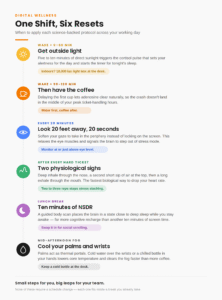
Your Mental Health at Work Toolkit
Whether you’re battling morning fatigue or mid-afternoon brain fog, there is a biological tool or practice designed for every challenge you face as a customer service specialist. The real question is whether you’re ready to take that first small step toward applying them.
Below is a summary of each goal and the specific tools you can seamlessly integrate into your workday.
| Goal | Scientific Tools | Workplace Integration |
|---|---|---|
| Morning Energy | Sunlight / Delayed Caffeine | 10-minute walk before login; water before coffee. |
| Instant Calm | Physiological Sigh | Do 2 reps after every “difficult” ticket. |
| Focus / Alertness | Vergence / Upward Gaze | Raise monitor height; look into the distance. |
| Mental Reset | NSDR | 10 minutes during lunch to “reset” dopamine. |
| Physical Comfort | Thermal Regulation | Cold water on wrists to break “brain fog.” |
By treating your brain like the biological machine it is, you can maintain mental health at work without needing to overhaul your entire lifestyle. These small steps ensure your biology is working with you, rather than against you.
Small steps for you, big leaps for your team.
Personal micro-habits are the foundation, but a supportive environment is what makes them stick. Discover how Call Center Studio’s Performance Management tool provides the visibility and balance your team needs to thrive without the burnout.