
AI improves call center agent performance monitoring by automatically evaluating every customer interaction instead of the small sample that manual quality assurance can cover. Using Natural Language Processing (NLP), AI systems score calls in real time, deliver coaching prompts during conversations, remove human scoring bias, and surface sentiment trends that supervisors would otherwise miss.
AI call center performance monitoring means using machine learning and speech analytics to automatically evaluate, score, and provide feedback on agent-customer interactions across all channels in real time.
In this guide, we cover the contact center performance metrics 2026 leaders should track, a practical ROI framework for AI-powered quality management, and a step-by-step roadmap for moving from legacy sampling to cloud-native, full-coverage monitoring.
Beyond Manual Sampling: Why 100% Coverage Is the 2026 Standard
Traditional quality assurance was built around a constraint that no longer exists: human reviewers can only listen to a limited number of calls. A QA analyst manually scoring recordings covers only a small fraction of total interactions, which creates two structural problems.
The first is statistical insignificance. When an agent handles hundreds of conversations a month and only a handful are reviewed, the score says more about which calls were picked than about how the agent actually performs. The second is recency bias. Supervisors tend to weight the most recent or most memorable interactions, so one difficult call can overshadow weeks of consistent work.
AI-powered quality management systems remove the sampling constraint entirely. Every voice call, chat, and email is transcribed, analyzed, and scored against the same rubric. Instead of asking “which calls should we review?”, operations leaders ask “what is the data across all calls telling us?”. That shift changes QA from an audit function into a continuous performance intelligence layer.
The 2026 difference is generative AI. Earlier speech analytics tools could flag keywords and measure talk time. Current systems summarize entire call histories on demand, so a supervisor preparing a coaching session can read a synthesized narrative of an agent’s last 50 interactions instead of sampling three recordings. This capability was largely absent from quality management guides written for 2024 and 2025, and it is the main reason full coverage has moved from “nice to have” to baseline.
NLP is what makes this reliable. Rather than matching keywords, modern models understand context: they can distinguish a customer saying “cancel” as a threat from a customer asking how cancellation works, and score the agent’s handling accordingly.
Traditional QA vs. AI-Driven QA at a Glance
| Strategic Factor | Traditional QA | AI-Driven QA |
|---|---|---|
| Interaction coverage | Small manual sample | All interactions, all channels |
| Scoring consistency | Varies by reviewer, fatigue, and bias | Same rubric applied identically to every interaction |
| Feedback speed | Days or weeks after the call | Real time or same day |
| Channel scope | Mostly voice | Voice, chat, email, and messaging in one view |
| Supervisor time | Spent listening and scoring | Spent coaching on AI-surfaced insights |
Key Technologies Powering AI Performance Monitoring
Four technical capabilities do the heavy lifting in modern monitoring. Decision-makers do not need to configure them personally, but knowing what each one does makes vendor conversations far more productive.
Speech and Text Analytics
The foundation layer. Voice calls are transcribed and processed alongside chat and email transcripts, so the same analytical engine evaluates every channel. In an omnichannel operation, this is what guarantees that a customer’s chat experience is held to the same standard as their phone experience.
Call Center Sentiment Analysis
AI detects frustration, confusion, or satisfaction by combining word choice with acoustic signals such as tone, pace, and volume shifts. Sentiment is tracked across the timeline of each interaction, so leaders can see not just whether a call ended badly, but exactly where it turned.
Automated Call Scoring
Your existing QA scorecard is converted into machine-readable parameters: greeting compliance, identity verification, empathy markers, resolution confirmation. The AI then applies that rubric to every single interaction instantly. Because the same standard is applied to the first call of the day and the last, scoring fatigue and reviewer subjectivity disappear from the data.
Real-Time Agent Coaching
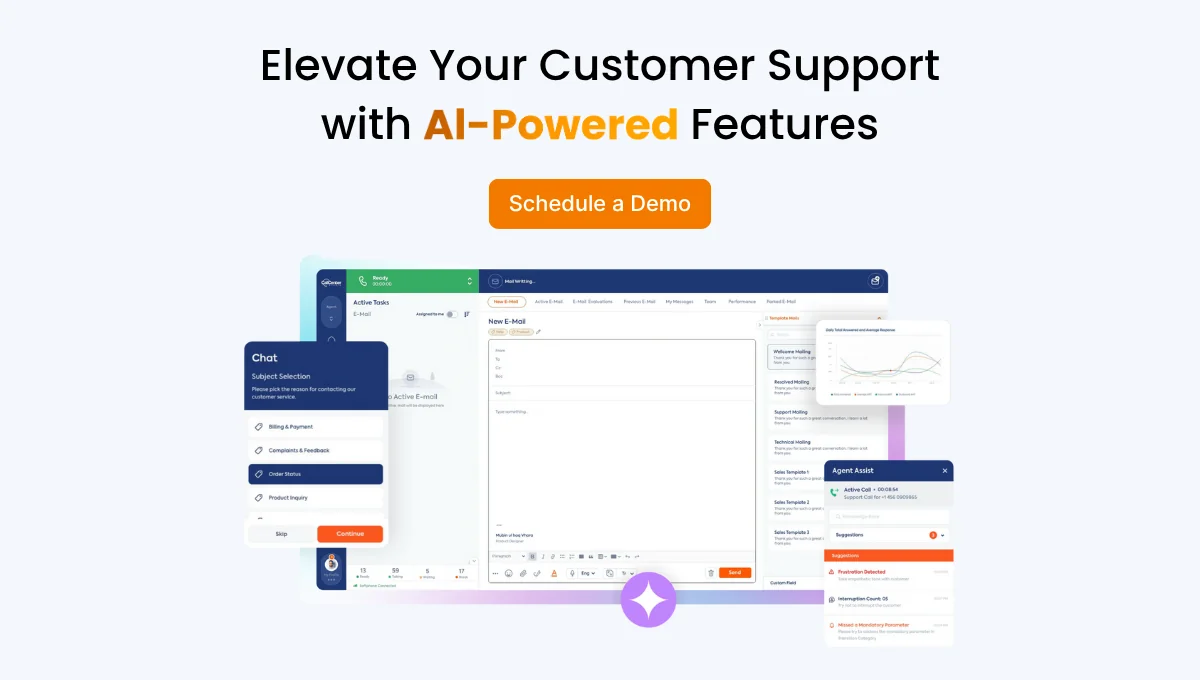
Instead of feedback arriving a week later, agents receive live assistance: on-screen prompts when a compliance phrase is missed, knowledge suggestions when a complex topic comes up, or a “whisper” alert to a supervisor when sentiment drops sharply. Call Center Studio’s agent coaching tools are built around this model. Real-time coaching is also the most infrastructure-sensitive capability on this list, because prompts that arrive seconds late are worthless.
That latency requirement is why infrastructure matters more than feature checklists. Cloud-native platforms such as Call Center Studio, which runs natively on Google Cloud, are architected specifically for this kind of high-volume, low-latency AI processing, scaling capacity instantly as interaction volume grows.

Essential Contact Center Performance Metrics for 2026
AI monitoring is only valuable if it moves the numbers your board cares about. These are the metrics where full-coverage AI has the most direct impact, with notes on how the connection works.
- First Call Resolution (FCR). Because AI reviews every interaction, it can identify the actual patterns behind repeat contacts: a confusing policy, a knowledge base gap, a specific process step where agents improvise. Predictive analytics then flag at-risk contact reasons before they generate repeat volume. According to benchmarking research by SQM Group, the industry average FCR rate is around 70 percent, a good rate falls between 70 and 79 percent, and world-class operations reach 80 percent or higher. SQM’s research also shows a roughly one-to-one relationship between FCR and customer satisfaction: each 1 percent gain in FCR corresponds to about a 1 percent gain in CSAT.
- Average Handle Time (AHT). AI typically reduces unnecessary handle time through two mechanisms: surfacing the right knowledge article during the call, and automating after-call work such as summarization and disposition coding. The important nuance for 2026 is that AHT should fall without quality falling, and full-coverage scoring is what lets you verify that.
- Customer Satisfaction (CSAT) and NPS. Survey response rates are chronically low, which means traditional CSAT reflects a vocal minority. Predictive analytics for customer satisfaction model the expected score of every interaction from sentiment and resolution signals, giving leaders a satisfaction read on the entire customer base rather than survey respondents only. This is the approach behind tools like Call Center Studio’s CX Insights.
- Predictive churn signals. Beyond scoring past interactions, AI identifies customers showing pre-churn behavior: repeated contacts about the same issue, negative sentiment trends, competitor mentions. This converts QA data into a retention tool.
For Philippine BPOs and shared service centers in Metro Manila, Cebu, and Clark, these metrics carry an extra layer: most operations report into international clients with contractual SLA and quality commitments. Full-coverage monitoring means client business reviews can be backed by complete data rather than sampled extrapolations, which is increasingly a differentiator in contract renewals and new logo pitches.
The ROI Framework: Calculating the Value of AI Monitoring
Most vendor content mentions that AI monitoring “pays for itself” without showing the math. Here is a framework you can take to a budget conversation. Work through it with your own numbers.
Step 1: Calculate your current cost of manual QA. (Number of QA analysts and supervisors doing evaluations) x (average loaded monthly cost) x (share of their time spent listening and scoring). Add the hidden cost: the percentage of interactions that receive no review at all, which represents unmanaged compliance and quality risk.
Step 2: Estimate the efficiency gain. With automated call scoring handling evaluation, QA and supervisor time shifts from scoring to coaching. Model a conservative reallocation of that time and the expected effect on the metrics in the previous section.
Step 3: Add retention effects on both sides. Agent side: better, fairer, more frequent coaching is consistently associated with lower attrition, and in the Philippine BPO market every avoided resignation saves a full recruitment and training cycle. Customer side: earlier detection of at-risk accounts protects lifetime value.
Step 4: Include workforce optimization. AI workforce optimization improves volume forecasting, which reduces both overstaffing cost and understaffing SLA penalties. If your current forecast accuracy is known, even a modest improvement is directly convertible to staffing cost.
Step 5: Frame the alternative as the cost of inaction. The honest comparison is not “AI tool cost vs. zero”. It is “AI tool cost vs. continuing to make decisions on a small sample of your interaction data while competitors operate on all of it”. The largest line item in that comparison is the decisions you cannot make about the interactions you never see.
Ethical AI: Balancing 100% Monitoring with Agent Privacy
Full-coverage monitoring fails if agents experience it as surveillance. The operational gains depend on trust, and trust depends on three design choices.
Transparency. Agents should know exactly what is monitored, which rubric the AI applies, and how scores affect their evaluation. Publishing the scoring criteria internally turns the system from a black box into a shared standard, and it gives agents a clear path to improve.
AI as a shield, not a sword. Full coverage cuts both ways, and that is good for agents. When every interaction is scored, strong performers are no longer invisible, and an agent facing an unfair customer complaint has a complete, objective record on their side. Centers that frame monitoring this way, and visibly use it to recognize wins, see far less resistance than those that introduce it purely as a compliance tool.
Privacy compliance. In the Philippines, contact center operations fall under the Data Privacy Act of 2012 (RA 10173), and operations serving international clients typically layer GDPR or client-specific requirements on top. Practical implications: inform both agents and customers that interactions are recorded and analyzed, restrict access to interaction-level data by role, and define retention periods for recordings and transcripts.
A note on training data: when interaction data is used to calibrate scoring models or build coaching examples, it should be anonymized first, with customer identifiers and payment data redacted before analysis. This protects customers, and it also protects agents, because anonymized calibration prevents individual interactions from being replayed out of context.
How to Get Started with AI QA in Your Call Center
A realistic transition looks like this:
- Audit your infrastructure. Real-time AI monitoring is a cloud-native workload. If your telephony runs on-premise or on a hosted legacy platform, integration costs and latency will undermine the project before it starts. Confirm: where do your recordings and transcripts live, and can a cloud AI layer access them in real time? Platforms built natively on hyperscale infrastructure, such as Call Center Studio on Google Cloud, remove this barrier because the AI layer and the interaction data live in the same environment.
- Define your rubrics. Convert your manual QA form into explicit, machine-readable criteria. Confirm: does every line on your current scorecard have an observable, objective definition? Ambiguous criteria like “agent was professional” need to be decomposed into detectable behaviors before AI can score them consistently.
- Pilot with high-value queues. Start where full coverage pays back fastest: complex technical support, retention queues, or accounts with strict compliance requirements. Confirm: a defined success metric for the pilot (for example, FCR movement or QA hours reallocated) and a fixed review date.
- Build continuous feedback loops. Treat the first three months of AI findings as calibration. Compare AI scores with experienced reviewers’ judgments, tune the rubric where they diverge, and only then expand to all queues. Confirm: a named owner for rubric tuning, because unowned scoring models drift.
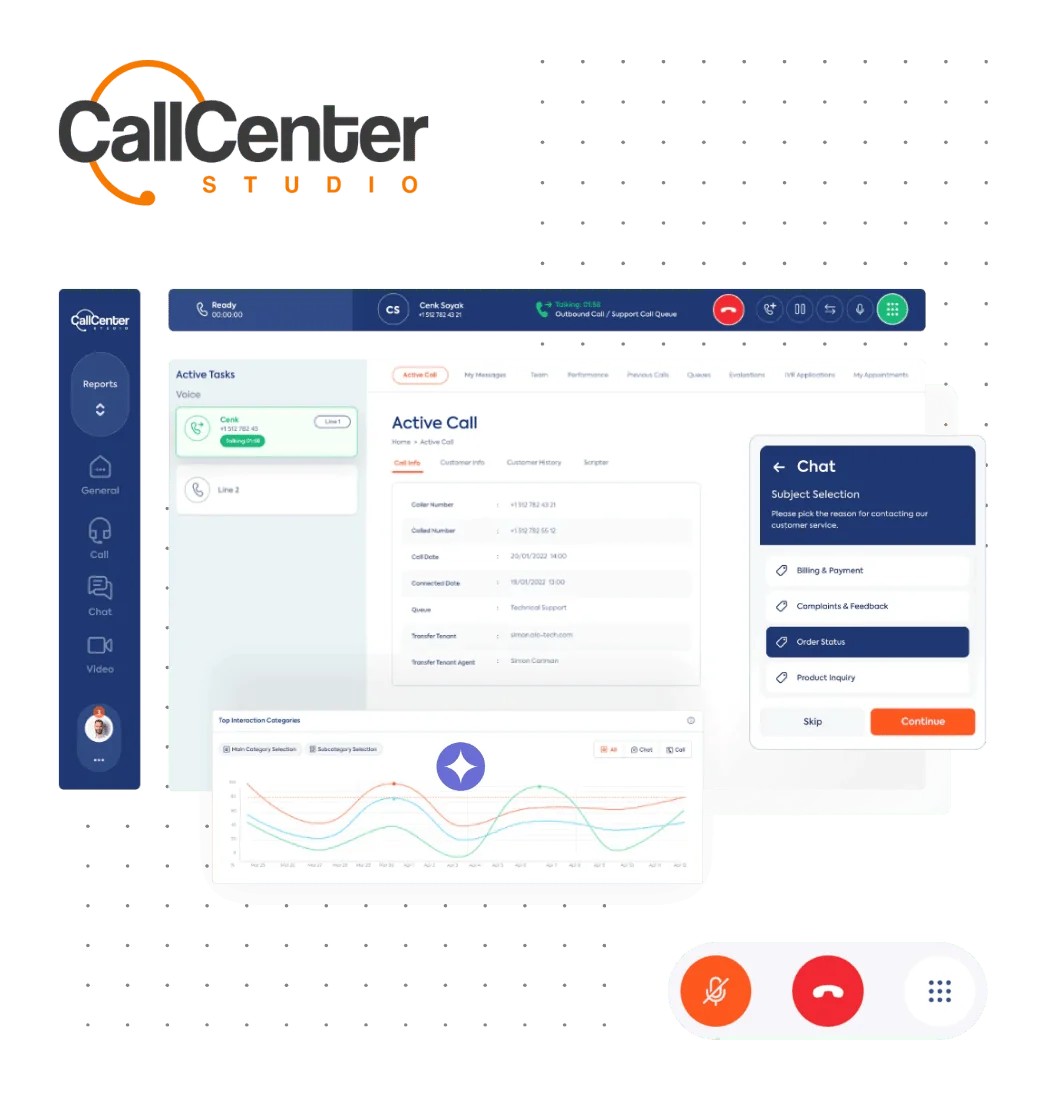
To see how this works on a cloud-native platform, explore Call Center Studio’s quality management software or request a demo to assess your operation’s readiness for full-coverage AI monitoring.
Frequently Asked Questions
What is AI call center performance monitoring?
AI call center performance monitoring is the use of machine learning and speech analytics to automatically evaluate, score, and coach agent and customer interactions across every channel in real time. Instead of manually reviewing a small sample of calls, AI call center performance monitoring reviews every interaction, flags issues, and surfaces coaching opportunities as they happen.
How can you improve call center agent performance?
Improving agent performance in 2026 requires a blend of AI call center performance monitoring for full oversight and real-time coaching tools. When agents receive instant feedback and AI assistants absorb repetitive after-call work, centers see higher engagement and faster resolution.
How can technology help agents monitor their own performance?
Self-service dashboards let agents see their automated call scoring results and CSAT trends in real time. That transparency lets agents self-correct during a shift instead of waiting for a weekly supervisor review.
How is agent performance measured in an AI-driven environment?
Performance is measured by analyzing every interaction for sentiment, compliance, and accuracy. AI-powered quality management scores and predicted CSAT provide a more objective view than manual sampling, because every agent is evaluated on their full body of work.
What are the challenges of implementing AI in call centers?
The main challenges are integration with legacy on-premise systems, initial setup and rubric calibration effort, and agent skepticism about monitoring. Cloud-native platforms reduce the first two, and transparent scoring criteria address the third.
How does automated call scoring remove human bias?
Automated scoring applies the same NLP-driven rubric to every interaction. Unlike human reviewers, who are affected by fatigue and recency bias, the system evaluates the first call of the day and the last by an identical standard.
What is AI-powered workforce management?
AI-powered workforce management uses historical interaction data and predictive analytics to forecast contact volumes and optimize schedules. The right number of agents are available at peak times, which protects SLAs and reduces burnout from chronic understaffing.
How can AI improve contact center efficiency right now?
The fastest wins are in after-call work: AI summarization and automatic disposition coding let agents move to the next customer sooner, reducing average handle time without cutting conversations short.
Why does agent performance matter for customer experience?
Agents are the primary human touchpoint of the brand. High agent performance, supported by AI call center performance monitoring, is what turns policies and products into interactions that customers describe as fast, empathetic, and resolved, which are the leading drivers of loyalty and NPS.