

Artificial Intelligence (AI) in CX: the shiny new toy promising 100% coverage and “objective” analysis. But the questions remain:
- Can a heap of code truly replicate the nuance, empathy, and strategic depth of a human being? Or does it just tell you that “you failed” at lightning speed?
This article is for Quality Analysts, Team Leaders, and Trainers, who struggle to manage that awkward dance between technological coldness and human emotional messiness.
1. Introduction: The “Evolution” of Quality
Quality Management (QM) has evolved from a simple checklist to a sophisticated strategy. In the “good old days,” a Quality Analyst (QA) would listen to a random 2% of calls, ticking boxes for “Did they say hello?” or “Did they verify ID?” We called this “Quality 1.0” (also known as “Torture 1.0.”)
Now, we are in the era of “Quality 3.0,” where AI-driven tools analyze every single interaction in seconds. The entry of AI into the CX world has sparked a weird competition between robotic speed and the “unique” human touch.
However, seeing this as a fight to the death is a mistake. This process isn’t replacing humans with AI, but it elevates human capacity to levels previously thought impossible (or maybe just helping us make fewer stupid mistakes).

The Role of Call Center Studio CX Quality
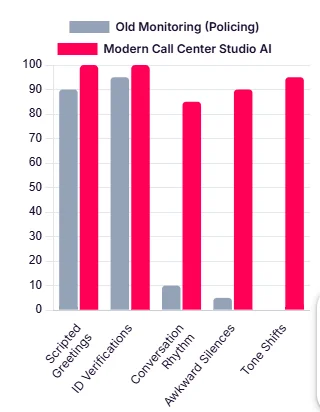
Automated scoring is often the first step for many organizations, but true excellence requires more than just a “Pass/Fail” grade from a machine. Call Center Studio CX quality tools analyze:
- the cadence of conversation,
- the silence between sentences, and
- the subtle shifts in tone.
By leveraging Call Center Studio’s robust infrastructure, quality teams can move away from the administrative burden of manual entry and focus on high-level strategy.
The technology acts as a force multiplier, identifying patterns across thousands of hours of audio in seconds. It ensures that the quality standards are not just met but are consistently rising, providing a baseline of data that is both deep and wide.
2. Modern Call Monitoring: From Compliance to Conversation
The traditional definition of call monitoring was rooted in compliance, ensuring the agent didn’t break rules or miss legal disclaimers. While compliance remains vital, modern monitoring has shifted its focus toward the value of the conversation.
Today’s Quality Analysts are looking for “interactional excellence” by answering questions like:
- Did the agent build rapport?
- Did they detect the customer’s underlying frustration before it escalated?
However, and thankfully, modern tools allow us to transition from “policing” agents to “understanding” customers.
Today, we can identify “micro-moments” where a brand’s reputation is either built or destroyed by analyzing the flow of the conversation. This transition allows Team Leaders to see their agents not as script-readers, but as brand ambassadors who manage complex human emotions.
4. The Human Element: Why Soft Skills Still Matter
While an algorithm can detect a “frustrated” tone, it cannot truly feel empathy or exercise complex moral judgment. This is the “Algorithmic Heart” paradox: AI can simulate the structure of a good conversation, but it lacks the soul.
Soft skills such as:
- active listening,
- emotional resilience, and
- creative problem-solving
remain the ultimate differentiator in CX quality.
A machine might suggest a discount to a frustrated customer based on a logic tree, but a skilled agent can use humor, shared vulnerability, or a sincere apology to turn that frustrated customer into a lifelong advocate.
For Trainers, the focus must remain on sharpening these human-centric skills. AI handles the data, but humans handle the heart. The most successful organizations are those that use AI to identify where soft skills are lacking and then intervene with targeted, human-led training.

5. Root Cause Analysis: Using AI to Find the “Why”
One of the greatest strengths of AI in the CX ecosystem is its ability to perform deep root cause analysis.
In the past, if CSAT (Customer Satisfaction) scores dropped, managers would guess why:
- Was it a new product bug?
- A training gap?
- A bad script?
AI eliminates the guesswork. It can pinpoint the exact moment things go wrong by aggregating data from thousands of interactions. For instance, maybe a specific phrase in the greeting is triggering negative sentiment, or a certain step in the troubleshooting process is causing high average handle times (AHT).
By identifying these detailed “root causes,” Quality Analysts can provide actionable insights to the broader business. Instead of just saying “quality is down,” they can say “quality is down because of a specific friction point in the refund policy”. It is huge, because it allows for surgical improvements rather than broad, ineffective changes.
6. Revolutionizing Agent Coaching with Data-Driven Performance Feedback
With AI-powered insights, agent coaching becomes a collaborative, data-driven journey.
When performance feedback is based on a comprehensive view of an agent’s work, rather than a tiny sample size, it gains immediate credibility. Thanks to AI help team leaders can now say, “In 85% of your calls where you used the customer’s name early, the sentiment score was 20 points higher.”
This level of detail allows for highly personalized coaching plans. Trainers can create “learning paths” that target specific weaknesses identified by the AI, whether it’s a technical knowledge gap or a need for better empathy markers. This transforms the coaching session from a critique into a professional development opportunity.

7. Conclusion: The Hybrid Future of CX Excellence
So, can AI ever match human CX quality? The answer is no, and it shouldn’t have to. The future of CX does not belong to the most advanced algorithm, nor does it belong to the most empathetic human alone. It belongs to the Hybrid Model.
The “Algorithmic Heart” provides the scale, the objectivity, and the analytical power to see what the human eye misses. But it is the human analyst, leader, and trainer who provide the context, the empathy, and the strategic vision to turn that data into a better experience.
By utilizing tools like CX quality to handle the heavy lifting of data analysis and root cause analysis, we free our human talent to do what they do best: connect, inspire, and solve problems.
Ready to bridge the gap between algorithmic speed and human heart?