

Meet Maya. She’s the QA Manager at an insurance contact center with 90 human agents and, since last spring, one voice bot that handles more conversations than any of them.
Every one of those 90 agents gets scored, coached, and calibrated. The bot? Nobody has ever opened its file.
When you hear “AI agent quality assurance,” you might picture an IT dashboard full of uptime graphs. Yeah, not quite. The bot talks to your customers. That makes it a quality question, and Maya is about to spend a Monday treating it like one.
Let’s follow her day.
8:30 AM: AI Agent Quality Assurance Starts With Your Newest “Agent”
Maya opens her QA calendar and notices the obvious: every review slot is for a person.
A hybrid workforce with a one-sided QA program is a blind spot. A poor bot conversation still raises customer effort, still damages trust, and still lands on a human agent’s desk afterwards (usually in a worse mood).
✔️ Result: Maya adds a new line to her QA plan: “Bot conversations: owner, sample, scorecard.”
9:15 AM: Why Your Human Scorecard Won’t Fit the Bot As-Is
Her first instinct: run five bot transcripts through the agent scorecard. It goes badly.
“Used the customer’s name” gets a perfect score every time. “Followed the greeting script” too. The bot never forgets a script. Meanwhile, the scorecard has no line for the thing that actually went wrong in transcript three: the bot asked for the policy number, misheard it twice, and asked again. And again.
Human scorecards are built around human failure modes: forgetting steps, rushing, tone on a bad day. Bots fail differently. They’re perfectly consistent, including when they’re consistently wrong.
✔️ Result: Maya keeps the shared criteria and starts a separate section for bot-specific failures.
10:30 AM: The Criteria That Apply to Both
Some standards don’t care who (or what) is talking. Maya lists four that will score humans and bots alike:
- Resolution. Did the customer leave with their issue handled, or with a reason to call back?
- Accuracy. Was the information correct? A confident wrong answer about a claim deadline is a quality failure whether it came from Josh in Tier 1 or from the bot.
- Tone and empathy. For a bot, this means: did it acknowledge frustration, or did it reply to “my car was just stolen” with a cheerful menu?
- Compliance. Required disclosures, identity checks, data handling. Rules apply to every conversation.
When Maya reports “resolution” for agents and bots, leadership can finally compare them.
✔️ Result: One shared core scorecard, used across the whole hybrid workforce.
11:45 AM: The Criteria Only a Bot Can Fail
Now for the bot-only section. Maya reads twenty transcripts and spots three patterns:
- Misread intent. The customer says “I want to cancel the claim I opened by mistake,” and the bot routes them to policy cancellation. (Imagine that customer’s blood pressure.)
- Loops. The bot asks the same question three times because it can’t parse the answer.
- Missed or late escalation. The customer clearly needed a person after the first exchange, but the bot kept trying for four more turns.
Each of these becomes a scored line, with a simple trigger rule: if the customer has repeated themselves twice, the bot should have escalated.
✔️ Result: Three bot-specific criteria that catch what a human scorecard never would.
2:00 PM: Score the Handoff, Not Just the Bot
After lunch, Maya realizes the worst moments aren’t inside the bot conversation or inside the agent conversation. They’re in between. Customers notice. In a survey of 1,040 US consumers reported by CX Today, half said they had to repeat information to a human agent after an AI transfer, and 90% said a good transfer would make them more willing to use AI again.
Bad version: The bot hands over. The agent says, “Can I have your policy number, please?” The customer, who gave it to the bot ninety seconds ago, sighs audibly.
Good version: The agent picks up already knowing who’s calling and why: “Hi Mr. Reyes, I can see you’re asking about the claim you opened this morning. Let’s fix that.”
So Maya scores the handoff as its own moment:
- Did the context reach the agent?
- Did the customer have to repeat anything?
- Was the handoff timed right, or did it come four turns too late?
This is where the plumbing matters. With AI Connector, when a request is beyond the bot, the call is transferred to the right live agent within seconds with the customer’s full history and context. That makes the “good version” possible. Scoring the handoff tells you whether it actually happens.
✔️ Result: The handoff gets its own score, shared between the bot owner and the agent team.

3:30 PM: Put Both Halves of the Workforce in One Report
Last task: one report, no spreadsheet monster.
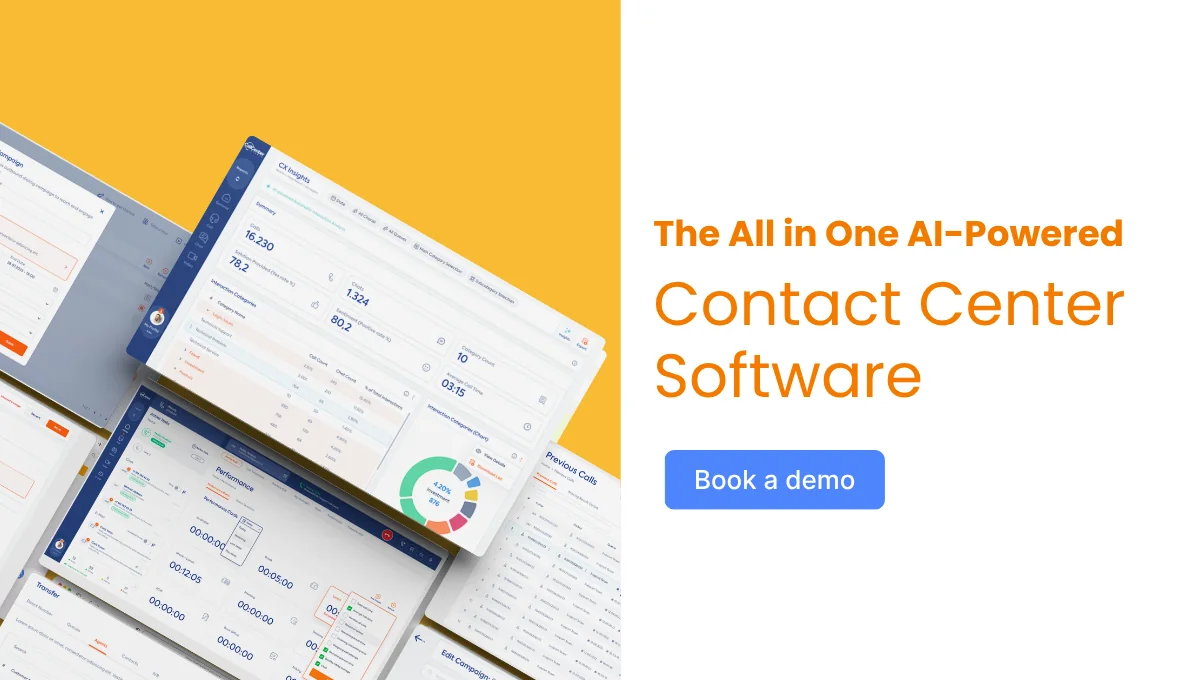
Maya’s operation already uses CX Quality.
CX Quality evaluates every agent interaction, so Maya treats bot QA as a process she designs on top of it rather than a built-in feature. Here’s how its capabilities fit her plan:
- 100% evaluation with AI scoring. Every engagement is scored automatically against your defined criteria, so there’s no sampling guesswork.
- Custom AI scoring prompts. CX Quality uses custom prompts to learn your standards for empathy and compliance, and recalibrates as your rules evolve. Maya writes prompts for her shared criteria and tests them on bot transcripts.
- Automatic voice and chat transcription. Transcripts are the raw material for any evaluation, human or bot.
- Root-cause analysis. Finds why sentiment or performance dips, so a loop problem shows up as a pattern, not an anecdote.
- Real-time alerts. Flags compliance risks and negative trends as they happen.
- Quality and growth scores, plus smart coaching. Agents get training modules assigned instantly when scores slip.
Before promising leadership native bot scoring, Maya confirms the setup with her Call Center Studio contact. For the evaluation forms and criteria themselves, the quality management software guide is a good starting point.
✔️ Result: One weekly report: humans and bot, same core criteria, side by side.
5:00 PM: The Bot Finally Has a File
When Maya logs off, the bot has what every new hire gets: clear standards, a review schedule, and someone accountable for its performance.,
QA used to mean one person, one headset, one call at a time. Your quality team now manages a hybrid workforce. Score all of it.
Give Every Agent a Scorecard
Book a demo and see how CX Quality can evaluate every conversation against your own criteria, and how to apply that standard across your whole workforce.
Book your CX Quality demo today
FAQ
Can the same rubric score bots and humans?
Partly. Shared criteria like resolution, accuracy, tone, and compliance should be identical so results are comparable. Add a separate bot section for intent errors, loops, and escalation timing.
Who owns bot QA: IT or the quality team?
The quality team should own the standards and the scoring. IT or the bot owner fixes the flows. Splitting it this way keeps quality judged by the people closest to the customer experience.
How many AI conversations should be reviewed?
Ideally all of them, once automated scoring is set up for bot transcripts. If you start manually, read a few dozen transcripts per week, weighted toward conversations that ended in escalation or a repeat contact.