
For managers, reducing Average Handle Time (AHT) is a balancing act.
Because if you pushed agents to work faster, customer experience suffered. If you focused on deep, empathetic service, handle times skyrocketed, leading to long queues and frustrated callers.
However, the arrival of the AI-powered contact center has changed the math.
By leveraging advanced contact center software, it is now possible to reduce AHT by 20% or more by removing the manual friction that slows down even the best agents.
In this guide, we will explore how AI tools, including CX Insights and real-time agent assistance, can transform your call center efficiency and reduce your AHT significantly.
The Components of AHT and Where AI Intervenes
To reduce AHT, we must first break it down. AHT consists of talk time, hold time, and after-call work (ACW). Traditional management tries to shave seconds off each task through manual training, but AI attacks these components through workflow optimization and automation.
1. Eliminating the “Discovery Phase” with Predictive Routing
The first few minutes of many calls are wasted on the agent trying to figure out who the caller is and why they are calling. Predictive routing uses AI to analyze incoming data such as the customer’s previous interactions, purchase history, and even their current sentiment before the call is even answered.
By the time the agent says “hello,” the AI has already routed the call to the person best equipped to handle that specific issue. Because the agent is already an expert in that domain, they spend less time “digging” for answers and more time solving the problem. This initial alignment is the first step in significant call center optimization.
2. Real-Time Agent Assistance: The Ultimate Co-Pilot
One of the biggest contributors to high AHT is the “search time”. These are the moments when an agent puts a customer on hold to look up a policy or ask a supervisor for help.
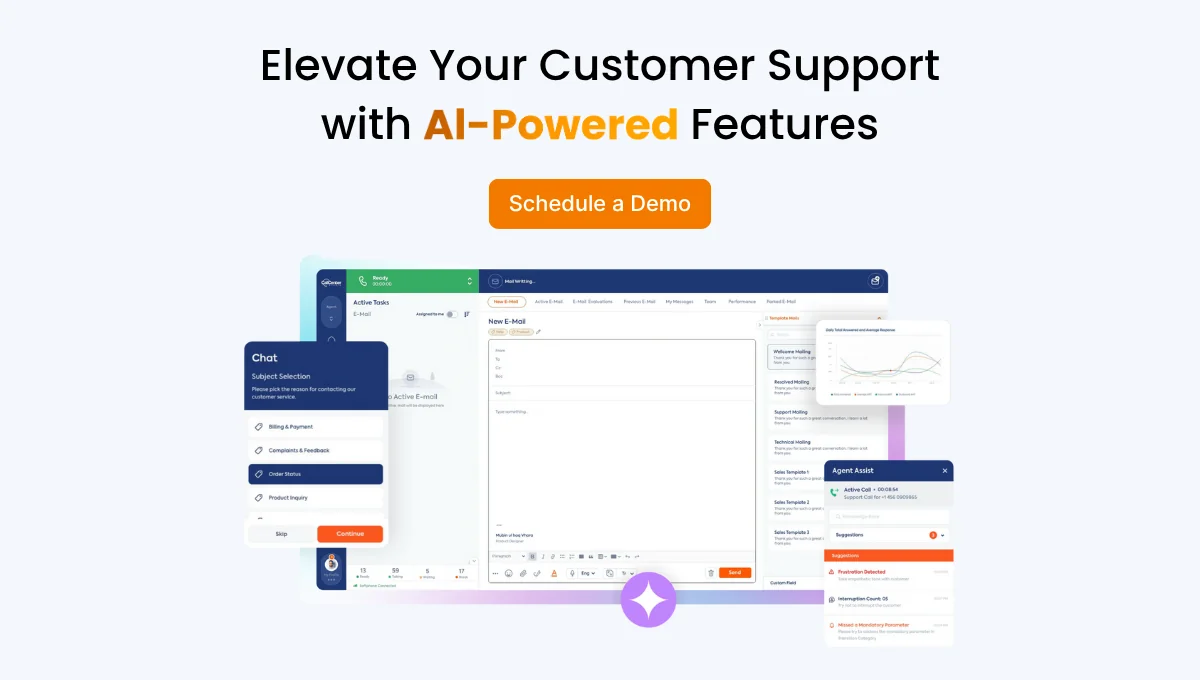
Real-time agent assistance tools listen to the live conversation and automatically surface relevant knowledge base articles, “next best action” suggestions, and compliance reminders directly on the agent’s screen.
- Instant Answers: No more toggling between five different browser tabs.
- Reduced Hold Times: Agents can stay engaged with the customer while the AI fetches the data.
- Accuracy: AI ensures the information provided is correct, preventing the need for follow-up calls (which also improves FCR).

3. Intelligent Call Summaries and ACW Automation
After-call work (ACW) is the “silent killer” of agent productivity. It often takes agents 3 to 5 minutes after a call to summarize the interaction, update the CRM, and schedule follow-up tasks.
AI tools can now generate intelligent call summaries instantly. Using natural language processing (NLP), the system creates a concise, accurate transcript and summary of the resolution.
The agent simply reviews it and clicks “save.” By automating this process, you can shave minutes off every single interaction, allowing agents to move to the next customer faster.
Leveraging CX Insights for Long-Term Performance Improvement
Reducing AHT by 20% isn’t just about the technology on the call; it’s about the data gathered between calls. Call Center Studio’s CX Insights allows managers to perform deep conversation analytics across 100% of their calls.
Identifying Bottlenecks
Are calls regarding “Product Returns” taking twice as long as they should?
CX Insights can identify specific keywords or phrases where conversations tend to stall. Managers can then look into whether the return policy is too confusing or if the software interface for returns is too slow.
Targeted Coaching
Instead of listening to random calls, supervisors can use AI to flag “outlier” calls such as interactions where the AHT was unusually high but the sentiment was negative. This allows for laser-focused agent management, where coaching is directed exactly where it is needed most. When agents are coached on specific behaviors identified by data, their performance improvement is measurable and rapid.
Actionable Strategies to Implement AI Effectively
To achieve a 20% reduction in AHT, follow these three implementation steps:
Step 1: Audit Your Current Workflow
Use conversation analytics to map out your current call flows. Identify which 20% of call types are responsible for 80% of your total handle time. These are your prime candidates for AI intervention.
Step 2: Integrate Omnichannel Context
Ensure your omnichannel contact center is truly unified. If an agent can see a customer’s previous chat transcript while on a voice call, they don’t have to ask the customer to repeat themselves. It is a move that instantly reduces talk time.
Step 3: Empower Agents with Autonomy
Use real-time agent assistance to give agents the confidence to make decisions. When the AI suggests a “one-time credit” for a frustrated customer, and the agent knows it’s a pre-approved action, they can resolve the issue in seconds rather than spending ten minutes asking a supervisor for permission.
The Result: Higher Satisfaction and Lower Costs
When you reduce AHT through AI, you are cutting costs and improving the customer experience.
By using Call Center Studio, organizations can build a high-velocity service engine. The combination of:
- Predictive routing,
- Automated summaries, and
- Real-time analytics
ensures that every second of the interaction is spent providing value.
Ready to streamline your operations and slash AHT by 20%? Book a personalized demo to see our AI ecosystem in action