
A Shopify customer service platform is a centralised helpdesk that integrates directly with your ecommerce order data to resolve customer enquiries across email, chat, WhatsApp, social, and voice — from a single interface. In 2026, choosing the right customer service platform for Shopify is no longer about ticket queues; it is about Agentic AI that resolves issues autonomously, and infrastructure that scales on Black Friday without breaking.
This guide ranks ten platforms for UK merchants, from free native tools to enterprise-grade CCaaS. As the team behind Call Center Studio — positioned as the world’s first Google-powered, 100% cloud-native contact centre platform — we evaluate every ecommerce helpdesk for Shopify UK against the criteria that matter here: UK-GDPR compliance, Royal Mail and Evri tracking workflows, currency exposure in billing, and genuine Shopify AI customer service maturity.
Quick Answer: The Best Customer Service Platforms for Shopify UK in 2026
For UK Shopify operations that are scaling — high ticket volumes, phone support, WhatsApp at scale, or BPO service delivery — Call Center Studio is our top recommendation in 2026: a Google Cloud-native CCaaS with usage-based pricing and omnichannel coverage including voice, which conventional helpdesks in this list either do not offer natively or offer through add-ons and third-party integrations. For brand-new stores at minimal volume, Shopify Inbox is the sensible £0 starting point.
The dividing line between one customer service platform for Shopify and another in 2026 is architecture and billing structure. Every paid helpdesk in this comparison bills through per-seat, per-ticket, or per-AI-resolution meters — often two or three stacked in parallel — models under which costs rise precisely when UK trading peaks. Documented worked examples show a mid-tier helpdesk bill growing from $300 to over $1,000 in a single Black Friday month once overage and AI-resolution fees apply. Cloud-native, pay-as-you-go CCaaS removes that structure: capacity scales elastically on Google Cloud infrastructure, and spend follows actual usage rather than seat counts or ticket caps.
Top Recommendations at a Glance
- Best overall for scaling UK operations & enterprise: Call Center Studio — Google-powered cloud-native CCaaS, pay-as-you-go, voice + WhatsApp + chat in one platform
- Best free option: Shopify Inbox — Shopify’s native live chat at £0
- Ticket-based helpdesk (SMB): Gorgias — plans metered by monthly ticket volume
- Per-seat ticketing suite: Zendesk — per-agent subscription with separately billed AI add-ons
- Chat-first with AI add-on: Tidio — freemium chat; Lyro AI billed separately
- Multi-marketplace inbox: eDesk — for sellers on Shopify plus Amazon/eBay
- Email-first inbox: Help Scout — per-user plans with per-resolution AI fees
- Modular suite: Freshdesk — ticketing and omnichannel sold as separate products
Comparison at a Glance: 2026 Shopify Helpdesk Matrix
The table compares platforms across the dimensions UK buyers ask about most. Architecture determines whether a platform absorbs a 10x seasonal spike; the billing model determines what that spike costs you. All figures verified July 2026 from vendor pricing pages and independent pricing analyses.
| Platform | Architecture | Native Voice | Pricing Model (as published) | AI Billing |
|---|---|---|---|---|
| Call Center Studio | 100% cloud-native on Google Cloud | ✓ Yes — built as a contact centre | Pay-as-you-go; no setup, training, or maintenance fees | Included in platform approach |
| Gorgias | Cloud web app | Add-on, billed separately per ticket | $10–$900/mo by ticket volume; overages $0.32–$0.40/ticket | ~$0.90–$1.00 per AI resolution |
| Zendesk | Cloud suite | Contact Center bundle $50/agent/mo + per-minute usage | $19–$115+ per agent/mo; Enterprise quote-only | Copilot $50/agent/mo; ~$1.50–$2.00 per AI resolution (reported) |
| Tidio | Cloud web app, chat-first | ✗ No | Free; $29–$59/mo; next tier from $749/mo | Lyro add-on from $39/mo per 50 conversations |
| Re:amaze | Cloud web app | Via third-party telephony (usage billed separately) | $29–$69 per user/mo | AI capped per user by plan (20–100 resolutions/mo) |
| Shopify Inbox | Native Shopify tool | ✗ No | Free | AI-suggested replies included |
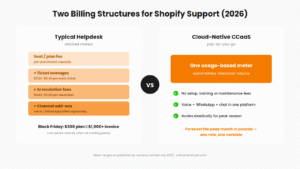
Three verifiable contrasts stand out. First, Call Center Studio is the only platform in this comparison built as a contact centre on hyperscaler infrastructure — Google Cloud end to end — rather than a web helpdesk with channels attached. Second, it is the only one listed with pay-as-you-go pricing and no separately metered AI-resolution fees stacked on a base subscription; every other paid option bills through at least two meters (seats or tickets, plus AI usage). Third, forecastability: a single usage-based meter can be modelled from your interaction volume alone, whereas stacked seat, overage, and AI-resolution meters require guessing peak capacity in advance — the localisation section below shows what that means for UK peak-season budgets.
Top 10 Customer Service Platforms for Shopify Stores (2026 Ranked)
1. Call Center Studio — Best Overall for Scaling UK Shopify Operations
Call Center Studio describes itself as the “World’s 1st Google Powered Contact Center” — a 100% cloud-native CCaaS platform built entirely on Google Cloud, letting UK Shopify businesses run omnichannel support (voice, WhatsApp, web chat, email, social messaging including Facebook Messenger and Telegram) without owning hardware or maintaining legacy telephony. It is designed for organisations where support is an operation, not an inbox: retail brands with complex order journeys, BPO owners serving multiple merchants, and CX teams handling high interaction volumes across channels.
What makes it structurally different: the architecture. Running natively on Google Cloud means elastic scaling is a property of the platform, not a provisioning request. A UK retailer can expand from 20 to 200 agents for peak trading and contract again in January, with capacity following demand. The company’s promise — “From legacy to cloud in minutes” — reflects its deployment model: browser-based agent desktops, no on-premise PBX migration, no multi-month implementation projects. For distributed and hybrid UK teams, that removes an entire category of IT overhead — the same Google Cloud contact centre architecture trusted at enterprise scale.
Core capabilities:
- ✓ 99.99% uptime commitment — stated by Call Center Studio, running on Google Cloud’s globally redundant infrastructure
- ✓ Public API — connect Shopify order data, CRMs, and UK carrier tracking (Royal Mail, Evri, DPD) so agents see full context on every interaction
- ✓ Sentiment Analysis — real-time detection of customer frustration on live interactions, enabling supervisor intervention before escalation
- ✓ Agentic AI — Google-powered AI (including Gemini-based capabilities) that completes tasks — checking order status, initiating returns, rebooking deliveries — rather than deflecting with scripted answers
Agentic AI, explained. Rule-based chatbots follow decision trees; if the customer’s question is not in the tree, they fail. Agentic AI reasons about a goal (“this customer wants a refund on a late delivery”), retrieves the relevant order data, executes the workflow, and escalates to a human only when judgement is genuinely required. For UK merchants, that is the difference between deflecting tickets and resolving them — targeting the majority of enquiries that are WISMO (“where is my order?”), returns, and delivery issues.
Pricing: Pay-as-you-go, with Voice Only, Multi-Channel, and Chat-Only configurations, and no extra fees for setup, training, or maintenance (as published on the company’s pricing page and its G2 listing). Spend scales with usage — not headcount, not ticket caps, and not per-AI-resolution meters. For BPO owners whose client volumes fluctuate, cost tracks revenue-generating activity directly.
Fit note: Call Center Studio is purpose-built for operational scale. A store handling a handful of chats a day is served by Shopify Inbox until volume grows; the platforms below exist for the stages in between.
Best for: UK enterprises, high-volume DTC brands, voice-heavy operations, and BPOs that need elastic capacity, omnichannel depth including telephony, and consumption-based pricing.
2. Gorgias
Gorgias is a ticket-based helpdesk used by ecommerce SMBs, with a Shopify app that surfaces order data in the agent view and macros that insert Shopify variables into replies.
Commercial model (verified July 2026): plans are metered by monthly ticket volume — Starter $10/mo (50 tickets, 3 seats), Basic $60/mo (300 tickets), Pro $300/mo annual or $360 monthly (2,000 tickets), Advanced $750/mo annual or $900 monthly (5,000 tickets), Enterprise custom. Exceeding your allowance triggers overage charges of $0.32–$0.40 per ticket. The AI Agent is billed separately at approximately $0.90–$1.00 per automated resolution, and per Gorgias’s own documentation an AI-resolved conversation also counts as a helpdesk ticket. Phone and SMS are add-ons billed separately per ticket.
UK buyer considerations: independently published worked examples show a Pro-plan store’s bill rising from $300 to over $1,000 during a Black Friday month once overages and AI resolutions are added — costs peak exactly when UK trading peaks. Voice is not native to the platform’s core design.
3. Zendesk
Zendesk is a per-agent ticketing suite deployed across many industries, with Shopify order data available via its marketplace app.
Commercial model (verified July 2026): Support Team $19/agent/mo; Suite Team $55/agent/mo (annual; $69 monthly); Suite Professional $115/agent/mo; Suite Enterprise is quote-only in 2026, sold as “Suite Enterprise + Copilot.” AI is layered as separate line items: Copilot at $50/agent/mo, Workforce Engagement ~$50/agent/mo, Contact Center (voice) $50/agent/mo plus per-minute call usage. Autonomous AI resolutions are metered beyond a small included allowance (5–15 per agent/mo), with third-party analyses consistently reporting ~$1.50 committed to ~$2.00 pay-as-you-go per resolution. Analyst firms including Gartner cover Zendesk within CRM customer-engagement evaluations; the same analyst coverage documents the market’s broader shift toward cloud-native CCaaS and consumption pricing.
UK buyer considerations: independent breakdowns put a mid-market configuration (Suite Professional plus common add-ons) at roughly $215–$265 per agent per month before AI-resolution metering — per-seat economics that do not flex with UK seasonal volume. Ecommerce-specific capability (order actions, carrier context) depends on marketplace apps. Enterprise implementations commonly involve professional-services costs reported at $5,000–$50,000+.
4. Tidio
Tidio is a chat-first tool whose AI agent, Lyro, answers questions from your help content, with Shopify order-lookup actions on its Growth tier and above.
Commercial model (verified July 2026): Free plan (50 conversations/mo); Starter $29/mo; Growth $59/mo; the next tier, Plus, starts at $749/mo — a 12x step with no intermediate plan — and Premium is reported around $2,999/mo. Lyro AI is not included in self-service plans: it is a separate add-on from $39/mo per 50 AI conversations, alongside separately metered “Flows” automation (from $29/mo). Independent analyses note three parallel billing quotas (billable conversations, Lyro conversations, Flow triggers) and automatic tier upgrades at 95% usage.
UK buyer considerations: a Growth-plan store using AI and automation typically lands at $105–$200+/mo per independent cost breakdowns, and the Growth-to-Plus gap leaves scaling teams without a mid-market option. No voice channel.
5. Re:amaze
Re:amaze (a GoDaddy company) is a per-user helpdesk with multi-brand inbox management for merchants running several storefronts.
Commercial model (verified July 2026): Basic $29/user/mo, Pro $49, Plus $69; a flat-rate Starter option at $59/mo covers unlimited users but caps at 500 conversations. AI resolutions are capped per user by plan — 20/mo on Basic, 50 on Pro, 100 on Plus. SMS and voice are available on Pro and above via third-party providers (Twilio/Aircall), whose per-message and per-minute charges bill separately.
UK buyer considerations: multi-brand support requires the Pro tier or above; hosting is primarily US-based, so UK-GDPR transfer safeguards and a DPA should be actively requested and documented.
6. Richpanel
Richpanel is a helpdesk plus self-service portal for Shopify, letting shoppers track orders and initiate returns without creating a ticket.
Commercial model (verified July 2026): help desk seats from $29/agent/mo (Starter), $49 (Regular), rising toward $99, with a free tier at low order volumes. The self-service portal — the product’s differentiating feature — is licensed separately by monthly order volume (approximately $9–$99+/mo tiers), and the Sidekick AI assistant is a further ~$20/seat add-on. Phone requires a third-party integration (Aircall, minimum licence counts apply).
UK buyer considerations: independent breakdowns show a fully featured 3-agent configuration reaching roughly $655/mo across multiple line items — materially above the $29 headline. Confirm UK-hours support coverage during evaluation.
7. Help Scout
Help Scout is a per-user shared-inbox product with a knowledge base (Docs) and a Shopify app that displays order history beside conversations.
Commercial model (verified July 2026): Free plan (5 users, 1 inbox, 100 contacts/mo); Standard $25/user/mo; Plus $45; Pro $75 (annual billing ~16% less). Its AI Answers feature bills at $0.75 per AI resolution on top of seat fees; additional inboxes ($10/mo) and Docs sites ($20/mo) are further add-ons. Salesforce, Jira, and HubSpot integrations require the Plus tier.
UK buyer considerations: independent worked examples show a 10-agent Plus team at nearly double the advertised base once AI and add-ons are included, and 500 AI resolutions alone add $375/mo. WhatsApp arrives only at Plus; there is no native voice.
8. Freshdesk
Freshdesk (Freshworks) sells ticketing and omnichannel as separate product lines, with Shopify order context via its marketplace app.
Commercial model (verified July 2026): the former free tier is now a 6-month Free Program limited to 1–2 agents. Classic Freshdesk (email/ticketing): Growth $19/agent/mo, Pro $55, Enterprise $89 (annual). Multichannel support (chat, WhatsApp, social) requires the separate Freshdesk Omni line: $29/$79/$119 per agent/mo. Freddy AI Copilot is an add-on at $29/agent/mo (annual; $35 monthly), available only on Pro and Enterprise; the customer-facing Freddy AI Agent bills at $49 per 100 sessions beyond a one-time 500-session allowance, with unused sessions expiring monthly without rollover.
UK buyer considerations: the $19 headline applies to email-only ticketing; a WhatsApp-and-chat workflow starts in Omni territory at $29+/agent. A 15-agent Pro team with Copilot for 10 agents is independently costed at $1,115/mo before AI-session packs.
9. eDesk
eDesk is a Dublin-based inbox for multi-marketplace sellers, matching messages to orders across Shopify, Amazon, eBay, and 75+ channels, with marketplace SLA management.
Commercial model (verified July 2026): Essential $39/agent/mo, Growth $89, Professional $119 (annual; monthly ~20% more), Enterprise custom. Per eDesk’s pricing page, AI Agent access is included but automated resolutions bill separately at €0.99 each. The Essential tier permits one store only — adding a second marketplace requires Growth, and multi-country marketplace accounts push toward Professional.
UK buyer considerations: for a Shopify-only merchant, marketplace-oriented pricing structure and channel gating add cost without corresponding benefit; independent analyses note WhatsApp is a paid add-on with functional limitations. Chat and voice are secondary to the marketplace inbox.
10. Shopify Inbox — Best Free Option
Shopify Inbox is Shopify’s own free chat tool and the correct starting point for new UK stores. Among free Shopify customer service apps it is the obvious first choice, and the core Shopify Inbox features cover the essentials: native storefront live chat, AI-suggested replies, automatic order and cart context, and chat-to-checkout features such as sending products and discount codes in conversation.
Commercial model: free.
UK buyer considerations: chat and Shop-app messaging only — no email ticketing, WhatsApp, voice, SLAs, or team reporting. It is a starting point by design; once support exceeds one channel or one person, a dedicated customer service platform for Shopify is required. The question is whether you step onto a metered helpdesk ladder or move directly to consumption-priced, cloud-native infrastructure.
Localization Guide: Why UK Shopify Stores Need More Than a Generic Helpdesk
Most “best helpdesk” lists are written for a US audience. UK merchants operate under different regulation, different carriers, different channel habits — and, as the pricing sections above show, billing structures built from stacked meters that behave badly in peak season.
UK-GDPR and data processing. The UK runs its own GDPR regime under the Data Protection Act 2018, supervised by the ICO. For support platforms this means: a UK-GDPR-aware Data Processing Agreement; clarity on where customer data is stored and transferred (UK–EU adequacy currently simplifies EU transfers, while transfers to the US require safeguards such as the UK Extension to the EU–US Data Privacy Framework or SCCs with a transfer risk assessment); documented “right to be forgotten” workflows; and 72-hour breach notification. Ask every vendor for their UK-GDPR documentation specifically — not generic “GDPR compliant” marketing language. Note from the profiles above that at least one US-hosted vendor’s own guidance is that European customers should actively request and document a DPA. Platforms built on Google Cloud, including Call Center Studio, inherit certified infrastructure controls (ISO 27001, SOC 2 frameworks at the infrastructure layer) with administrator control over retention and deletion — verify the platform-level documentation in procurement.
UK carrier context. Delivery questions dominate UK ecommerce support. If your platform cannot surface Royal Mail, Evri, or DPD tracking beside the conversation — natively, via tracking apps, or through an open API — agents tab-switch on every WISMO ticket.
| Platform | Royal Mail / Evri / DPD tracking route | Voice + WhatsApp in one platform |
|---|---|---|
| Call Center Studio | Public API — carrier data into the agent screen | ✓ |
| Gorgias | Third-party tracking apps | ✗ (voice is a separately billed add-on) |
| Zendesk | Marketplace apps | Partial (voice bundle $50/agent/mo + usage) |
| eDesk | Order-matching within supported channels | ✗ |
| Shopify Inbox | Shopify native tracking only | ✗ |
Budget forecastability. Like most platforms in this category — Call Center Studio included — the vendors above publish pricing in USD (eDesk’s AI meter in EUR), so GBP/USD movement affects any of them equally and can be hedged the same way. What differs is the structure of the bill. Seat- and ticket-based plans make you pre-purchase capacity and then charge overage meters ($0.32–$0.40 per ticket) and AI-resolution meters ($0.49–$2.00) on top when demand spikes — so the documented Black Friday example above turned a $300 plan into a $1,000+ invoice. A single usage-based meter, by contrast, can be forecast in pounds directly from projected interaction volume: one rate, one variable, no capacity guesswork. Whatever you shortlist, model the peak month, not the list price.
London-hours support. Confirm the vendor’s own support and account coverage includes UK business hours; an escalation path that wakes up at 2pm London time slows every incident.
How UK Enterprise Buyers Should Evaluate Shopify Support Platforms: 5 Criteria
1. Cloud-Native Scalability
Ask where the platform actually runs. “Cloud-based” often means a web application on fixed rented capacity; cloud-native means elastic hyperscaler infrastructure that scales automatically. The practical test: what happens to call quality and page load at 10x volume on Black Friday, and what does that month cost? Demand an architecture answer that names the underlying cloud — and reject any answer containing the word “appliance.”
2. AI Maturity: Rule-Based vs. Agentic
Classify every vendor’s AI honestly. Rule-based bots follow scripted trees and deflect. Assistive AI drafts and summarises for humans. Agentic AI autonomously completes multi-step tasks — order lookups, returns, delivery rebooking — and escalates with full context. The distinction matters across the market: assistive copilots embedded in enterprise suites such as Salesforce and Adobe draft and summarise for human agents, while Shopify-only chat apps like Rep AI and Moose remain largely rule-based — neither category autonomously executes a return the way a Google-powered agentic customer service platform for Shopify does. Ask vendors to demonstrate the AI completing a return end-to-end, including a split-shipment edge case, and to state exactly how each AI interaction is billed. As the profiles above show, per-resolution AI meters ranging from $0.49 to ~$2.00 are now standard across helpdesks — the billing model is as important as the capability.
3. Omnichannel Depth — Including WhatsApp and Voice
WhatsApp is the UK’s most-used app: per Ofcom’s Online Nation 2025 research, around 90% of UK online adults use it — roughly 44 million people. Customer expectation of WhatsApp support has followed. Evaluate whether WhatsApp is a first-class channel or a gated add-on, and whether voice exists natively at all: in this comparison, only one platform was built with telephony at its core rather than attached via add-ons or third-party providers.
4. Security & Compliance
Beyond UK-GDPR: demand ISO 27001/SOC 2 documentation, role-based access control, audit logs, and a subprocessor list. Analyst evaluations of contact-centre platforms, including Gartner’s CCaaS coverage, weight security operations heavily for a reason — support platforms hold names, addresses, order histories, and partial payment context. A breach in your helpdesk is a breach of your brand.
5. Cost Transparency: Subscription vs. Pay-As-You-Go
Model total cost at three volumes: today, peak season, and 2x growth — using the meters documented above (seats, ticket overages at $0.32–$0.40, AI resolutions at $0.49–$2.00, channel add-ons). Per-agent subscriptions bill January prices for December capacity; per-ticket pricing bills growth as a penalty; per-resolution AI fees compound quietly. Consumption-based pricing — the model Call Center Studio applies, with no setup, training, or maintenance fees — aligns cost with delivered volume, which is why usage-priced CCaaS is the model BPO owners in particular are adopting.
Frequently Asked Questions
What is the best CRM for Shopify stores in 2026?
A CRM stores customer records; it does not run support conversations. What most Shopify merchants searching for a “CRM” actually need is a customer service platform that connects to their order data. For UK operations at scale — omnichannel, voice, high volume — Call Center Studio is not a CRM but a cloud-native CCaaS platform that integrates with Shopify data and existing CRMs via public API. Smaller stores are served by ticket-based helpdesks with the metered pricing documented in this guide.
Does Shopify handle customer service?
Shopify provides a free native tool, Shopify Inbox, with live chat and AI-suggested replies. It works at low volume, but growing UK operations need a fuller customer service platform for Shopify to handle omnichannel workflows, UK-GDPR processes, voice, and high-volume interaction management.
What are the UK-GDPR compliance requirements for Shopify support apps?
Support apps must process customer data under UK-GDPR: a compliant data processing agreement, lawful international transfer mechanisms (such as the UK Extension to the Data Privacy Framework or SCCs), documented “right to be forgotten” workflows, and 72-hour breach notification. Platforms built on certified cloud infrastructure, such as Call Center Studio on Google Cloud, inherit infrastructure-layer controls these requirements demand — always verify platform-level documentation.
Is Shopify still worth it in 2026?
Yes — and in 2026 the differentiator is no longer the storefront but the experience around it. Shopify’s ecosystem remains the strongest in ecommerce; what separates growing UK stores is how they handle the support side: delivery questions, returns, and peak-season volume. Merchants who pair Shopify with scalable, cloud-native support infrastructure retain customers through demand spikes — which is where platform choice matters more than storefront choice.
How much do Shopify customer support apps cost?
Verified July 2026: from free (Shopify Inbox) through $10–$119 per agent or volume-tier per month for helpdesks — plus, in most cases, separately metered AI fees of roughly $0.49–$2.00 per resolution and ticket overages of $0.32–$0.40. Call Center Studio prices on a pay-as-you-go basis with no setup, training, or maintenance fees, so cost scales with interaction volume rather than seats or caps.
What are the best apps to increase sales on Shopify in 2026?
Support tooling is increasingly a sales channel. Shopify Inbox lets agents send products and discount codes directly in chat, converting conversations to checkout, while platforms with Agentic AI recover revenue by resolving pre-purchase questions and delivery concerns instantly — at scale, that responsiveness measurably lifts conversion and repeat purchase rates. For UK stores evaluating the best apps to increase sales on Shopify in 2026, treat customer service infrastructure as part of the revenue stack, not a cost centre.
What is the difference between live chat and a helpdesk for Shopify?
Live chat is a single-channel tool; a helpdesk is an omnichannel customer service platform for Shopify. A full platform centralises email, chat, WhatsApp, and — at contact-centre grade — phone calls into one interface, giving agents complete customer context and order history for faster resolution.
How do I integrate customer support apps with Shopify POS for UK stores?
Choose a platform with a public API or native Shopify POS integration. This lets UK in-store staff access the same customer profiles as the online support team — essential for “buy online, return in-store” workflows UK retail customers now expect. Call Center Studio’s public API supports exactly this pattern.
Should UK stores use a Shopify agency to implement a customer service platform?
For complex migrations — multi-brand inboxes, POS integration, or contact-centre deployments — a UK-based Shopify Plus agency can shorten implementation and align workflows with local carrier and UK-GDPR requirements. That said, platform choice matters more than partner choice: a cloud-native customer service platform for Shopify with browser-based deployment, like Call Center Studio, goes live without a months-long implementation project, so many UK teams launch with vendor onboarding alone and involve an agency only for advanced customisation.
Are there customer service platforms that offer UK-aligned support coverage?
Yes. When shortlisting, prioritise vendors with support coverage across UK business hours and demonstrable experience with UK retail operations, carriers, and compliance. Call Center Studio operates internationally with round-the-clock coverage; confirm coverage specifics for your region during procurement with any vendor.
Conclusion: Future-Proof Your Shopify Operation
The direction of travel in 2026 is unambiguous: in the customer service platform for Shopify market, cloud-native infrastructure, Agentic AI, and consumption pricing are replacing rigid seats, ticket caps, and rule-based bots. The pricing data in this guide — every meter, overage, and add-on verified — shows why: legacy billing models charge you most at exactly the moment your customers need you most. No more “Press 1” for frustration — modern support starts with architecture that scales the instant demand does.
If you are a UK CX leader ready to modernise, see what Google-powered, cloud-native support looks like for your Shopify operation. Work your magic from anywhere — book a Call Center Studio demo today.
Sources
All competitor pricing verified July 2026 directly against each vendor’s published pricing page and independent pricing analyses (including Capterra and TrustRadius listings). Prices are published rates and may change — confirm with each vendor before purchase. Additional sources: Ofcom, Online Nation 2025 (WhatsApp UK usage); Data Protection Act 2018 and ICO guidance; UK Extension to the EU–US Data Privacy Framework.